Animal Legal Defense Fund Student Chapters celebrate National Justice for Animals Week (NJFAW) the last week of February every year. NJFAW is dedicated to raising public awareness surrounding crimes against animals. This starts with learning what kinds of animal maltreatment count as criminal cruelty under the law. From there, we use the perspective of animal interests to inform how to respond to those crimes: intervening early before criminal cruelty occurs, or — if cruelty has already happened — ensuring that it is treated as a crime against a someone rather than a something. This leads us to prioritize outcomes that focus on restoring the animal victim to health, identifying and addressing cruelty risk factors, and preventing future cruelty from taking place. Finally, we circle back around to ask — from the perspective of animal interests — how current criminal cruelty laws can be improved.
To support student chapters in their planning, the NJFAW Student Chapter Project Kit contains activity suggestions, resources, ideas, and action items to plan and host events throughout the week.
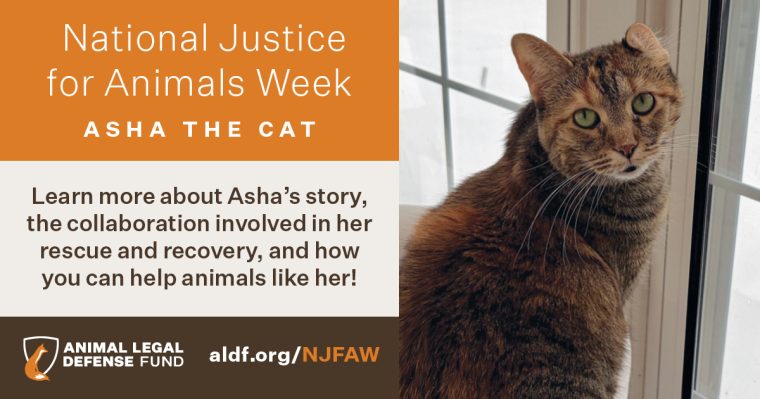
Each year, a special representative — an animal whose experience with the justice system helps illustrate the law’s power to do more for animals — is selected. Learn more about the 2026 representative – Asha the cat.
The week of awareness is capped off with the announcement of America’s Top Animal Defenders, which is the list of prosecutors, judges, law enforcement officials, animal rescuers, lawmakers, animal legal advocates, and others who champion the cause of animal crime victims. Learn more about the 2026 Defenders.
Project ideas
Student chapters may apply for project grants to help cover costs, and there is no cap on number of times that a chapter can apply. Grants can cover plant-based food, t-shirts, books, and more! Funding is on a rolling basis.
Research and Discuss Your State’s Animal Protection Laws
Every year, the Animal Legal Defense Fund publishes its U.S. State Animal Protection Laws Ranking Report. This report is the longest-running and most authoritative of its kind, assessing the strength of each state’s animal protection laws by examining over 3,400 pages of statutes and ranking states using 20 different categories of animal protection.
Student chapters, either together or individually, are encouraged to research your state’s ranking report and assess what is working well, what needs improvement, and what is completely lacking. Chapters can plan around this report to create many different event types! Some ideas include:
Host Trivia!
 Plan and host a trivia event to educate members on cruelty laws while having fun.
Chapters may use either the trivia questions provided or come up with their own. Chapters can also do a combination of supplied questions and unique trivia questions for your specific state.
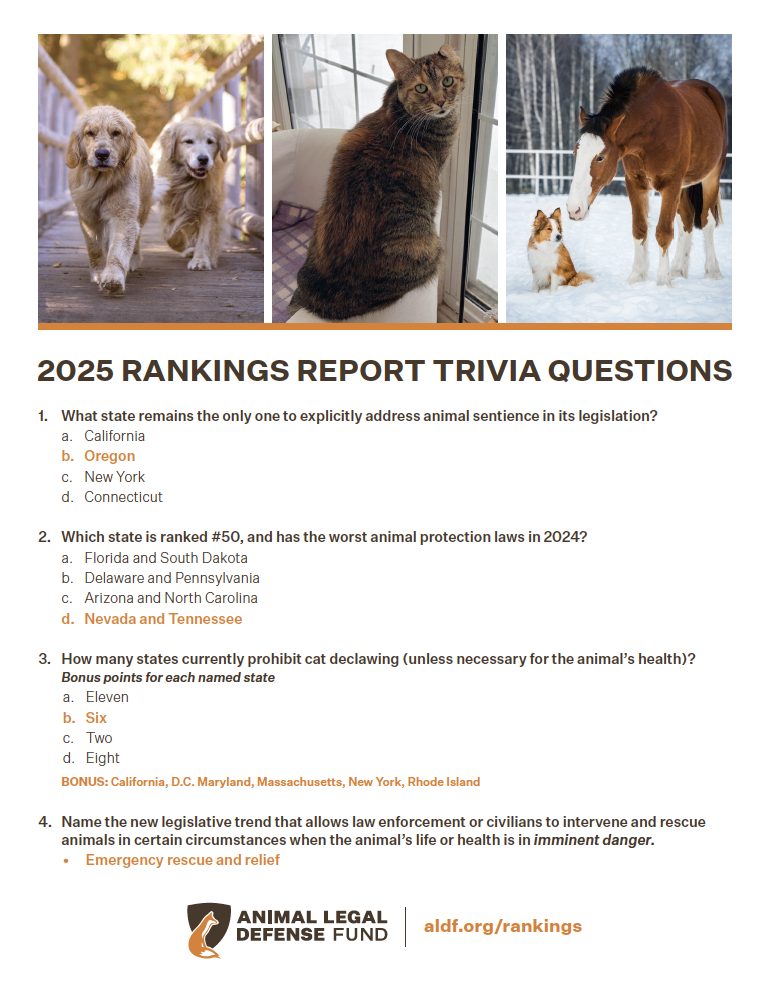
Ranking Report Trivia Questions
15 Q&As from the 2025 U.S. State Animal Protections Law Ranking Report
Some ideas for planning a trivia event:
- Decide on logistics, including time of day and location. Possibilities include lunch time on-campus or evening on- or off-campus at a nearby venue.
- Will there be prizes? We recommend asking local businesses to donate fun prizes for student members to win — or ask your school bookstore to donate some swag! Get creative, have fun, and reach out to your community for support. Lean on your favorite professors to offer creative prizes, such as dinner with the professor, homemade craft, or fun activity.
- Decide whether members will compete as teams or individuals. If teams, encourage them to form teams before the event so that the event can start right on time.
- Create engaging follow-up conversation based on the trivia content. What were the takeaways that members learned from the trivia answers? What surprised members? What do members want to learn more about in future meetings?
Assign, Present, & Discuss
Assign interested chapter members a category from the report to research, then have each student present their results and discuss with the group.
Larger chapters might need additional coordination. After assessing interest, you can send out a sign-up sheet for different sections of the report, or create a form to help assign sections to individual students or small groups. The presentations and discussions can be as formal or informal as you’d like — as examples, there could be a roundtable discussion with students chatting about their research with others, or you could get really fancy and create a PowerPoint. Up to you! Some discussion topics can include:
- Your own state’s animal protection laws, including strengths and weaknesses
- Possible solutions for weak laws that do not represent animals’ interests
- Most surprising findings from the report
- Anything else interesting or relevant
Bring in a Speaker
 After chapter members have time to browse your state’s ranking report, host a speaker to delve deeper into the topics! Please see below Host or Join a Speaker Event for more details on how to plan.
Select an Area for Legislative Change
 Depending on your state, your chapter might be able to get involved with passing legislation that strengthens animal protection!
After research and discussion, identify areas that are lacking with special attention to your local area. You can also compare with other similarly situated states to find alternative solutions, growth opportunities, and previously successful campaigns. If your chapter is interested in working on legislation, you can learn how to work with legislators, please check out the written guide or the Lobbying and Local Ordinance webinars as part of the Education Center.
Get Involved with Social Media
Social media is an invaluable tool for educating others about animal law issues and building community engagement. Use this week of action to reach a wider audience with our content suggestions below, or as an excuse to create a social media presence if your chapter hasn’t yet. There are endless content possibilities and topics to explore! Be sure to follow the Animal Legal Defense Fund on its social media platforms to cross share posts and stay up to date.
Create an Instagram Reel, TikTok, or YouTube Short
 Create video content on an animal protection issue important to you! Use the hashtags #ALDF and #NJFAW for a chance to be featured on our Animal Legal Defense Fund social media accounts.
Cutest Companion Animal Contest
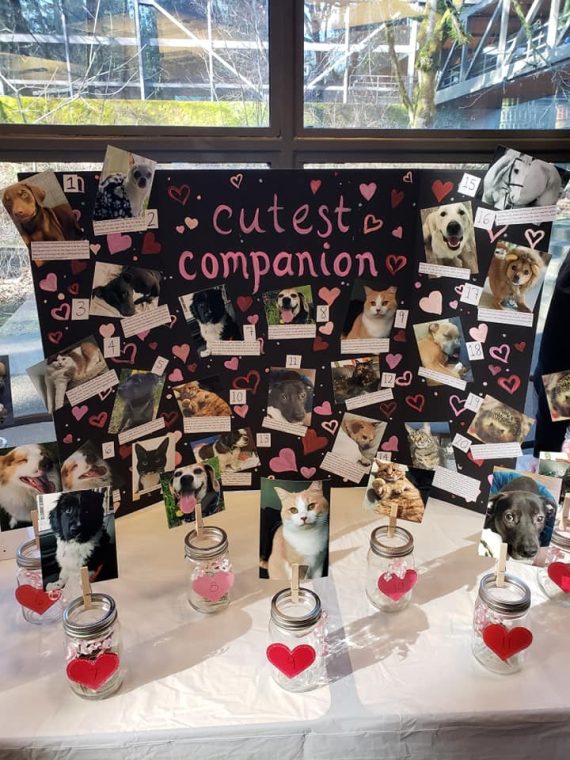
Host a Cutest Companion Animal Contest on social media! This is a great way to fundraise, interact with fellow students and faculty, and gain follows and support. People can submit their companion animals, which are then voted on during NJFAW through donations. And all proceeds going towards a local shelter or organization. The companion animal who raises the most money wins!
Typically included with each posting is one photo, a name, and a one-sentence description. This event can be done on-campus, virtually, or a hybrid. For this purpose, we’ll stick with virtual planning.
Call for submissions
Announce the contest and set up a way for people to submit their animal photos, either through a Google Form, email, or direct message. Don’t forget to provide a deadline! Submission guidelines could include providing their name, email, companion animal name, one photo, and a brief sentence description.
Promote
Once you have all the photo submissions, use Canva (or your editor of choice) to make social media graphics to include the photo, animal name, and description.
Announce the contest to your followers and promote via social media. If you’re still growing your following, consider promoting the event via fliers on-campus or email. Provide details about the contest, how it works, and the deadline. Also include information about the shelter or organization that will receive the contest’s donations.
Collecting donations
The easiest way to collect donations is through a mobile payment app. Other chapters have used Venmo, Cash App, and Paypal.
Optional prizes
While not necessary, some chapters have been successful in asking businesses to donate items for fundraising purposes. It doesn’t hurt to ask! Prizes can be given out to the winners: first-place only, top three, or based off a different system (such as most voted dog, most voted cat, most voted bird, etc.) This is fun way to incentivize people to participate!
Please be mindful that businesses might ask for a receipt. For more information, please visit the IRS Charitable Contributions – Written Acknowledgement section.
Ready, Set, Go!
- Leading up to voting opening, promote the contest to get everyone excited and ready to cast their votes.
- On the first day of the contest, post the submissions, along with instructions on how to vote:
o Example post: The Cutest Companion Contest is here! Cast your votes for your favorite(s) by donating via Venmo/Cash App/Paypal, any and all amounts accepted. In the memo, please include the name. At the end of the week, the companion animal who raises the most money gets bragging rights for the rest of the year. All donations will go to XYZ, a shelter/organization that [insert mission statement or description]. Thanks for the support by sharing and voting! - If you received donated prizes, mention them here and include a shoutout to the business(es) that supported.
- Throughout the week, you can do additional promotion either generally or by highlighting each submission separately. Also continue to post about other NJAW activities, animal law topics, and other ways to get involved.
Wrapping up
At the end of the week, calculate results and get ready to announce! You can create certificates for the winners, design a special post to make the announcement, or create a video.
Donate
One of the best parts is when you get to let the shelter or organization know how much you raised! You can share that funds have been donated and thank everyone again.
Host a Speaker Event or Replay Webinars
Hosting a speaker event is a quintessential chapter project! Chapters can request a speaker from the Animal Legal Defense Fund year-round, invite someone locally, or watch a replay of a previously recorded video. For a full list of possible recordings, please check out the Education Center’s National Justice for Animals Project Kit bundle. Select recordings have corresponding discussion questions for chapters to use for further discussion, along with additional materials.
Examples include:
- Wildlife as Crime Victims
- The Ethical and Legal Quandaries of Animal Cruelty in a Digital Age
- NJAW 2022: Defining Justice
- Vindicating Pierson v. Post’s ‘Saucy Intruder’: Of Wildlife Crimes & Crimes Against Wildlife
- Animal Victims and Restorative Justice
- Critical Caselaw: Judicial Recognition of Animal Sentience
Tabling to Raise Awareness
 Tabling is a great way to directly engage with your law school community and to inform them about the importance of animal issues, ways to get involved, and upcoming events. Students can request National Justice for Animals Week tabling materials, which includes relevant brochures and special NJFAW stickers.
Tabling tips:
- Organize your table so that the NJAW brochures and freebies are visible.
- Have at least one action item. Some examples include:
- Tabling materials include a poster with a QR code to make taking action easy for students
- Signing up for the chapter’s email list
- Signing up for the Animal Legal Defense Fund email updates
- Watch a video by the Animal Legal Defense Fund on anti-cruelty laws, companion animals, or criminal law
- Have fun and be responsive! Sometimes people can feel unsure coming up to a table, so put their mind immediately at ease with a welcoming vibe, snacks, and freebies that they can take with them.
- Encourage chapter members to join in tabling. It’s an easy way to practice and gain confidence discussing animal issues, as well as learn what interests other students.
- Take pictures! Be sure to use #ALDF and #NJFAW.
- Apply for a project grant to help cover plant-based snacks for the table.
Collaborate
Partnering with other student clubs on campus, regional student chapters, and bar association animal law sections can bolster your events even more by spreading out the work, bringing in new audiences, and sharing cross-connected information that might not otherwise be explored.
Research adjacent student groups at your law school. Those with common interests could be open to collaborating on an event or campaign. Some cause areas might include:
- Environmental law
- Workers’ rights
- Public health
- Food law
Feel free to search our list of active Animal Legal Defense Fund Student Chapters for other nearby or regional groups to partner together on events.
Bar Association Animal Law Sections and Committees are a potential source of speakers, mentors, and collaborators.
Building Collaboration and Bridging Gaps
As part of this year’s NJFAW theme on collaboration, student chapters are encouraged to start conversations to build partnerships among community leaders and stakeholders. Below are examples of ways to begin. Since there are many ways for this project to expand out for a chapter, only idea prompts have been provided. For chapters interested, and if unsure of how to start, reach out to Priscilla! We are happy to help plan something that will work best for your chapter.
- Engage with community outreach organizations that are not just animal welfare related (older adult groups, food banks, veteran support groups, etc.) and bring an animal-forward perspective to their tables.
- There are many ways to combine interests as it relates to animal issues. domestic violence shelters that work with companion animals or offer plant-based meals during food drives.
- Volunteer with shelters/rescues and use that space to educate staff on the resources provided by the ALDF’s criminal justice team, including training for law enforcement and humane officers, assistance with criminal seizures and protective custody housing of animals, and more.
- If you are in a position to foster, foster animals held in protective custody.
- Communicate with veterinary colleges in your area to ensure that they include recognizing, reporting, and responding to animal cruelty cases in their curricula.
- Bring resources to your local veterinarian’s office with information on reporting animal cruelty.
- Promote awareness and action via social media by sharing posts that illustrate appropriate responses to animal cruelty, state laws (tip: use the U.S. Rankings Report for your state!), successes, and more.
- Attend conferences, community fairs, and other events to promote recognizing and reporting animal cruelty. These events do not necessarily need to relate to animals directly.
- Look for opportunities to assist with outreach events aimed at preserving the human bond by providing veterinary care and support to individuals experiencing houselessness or poverty.
- If there is a task force in your community that addresses animal cruelty, hoarding, the Link, and other issues, consider joining and becoming an active participant.
Learn About and Celebrate Recent Victories to Educate Others
We recognize that advocating on behalf of animals, while immensely rewarding, can be challenging and arduous. Years of work can lead to lost cases or legislation stalling out, and some days it’s hard to find success. But we are winning, and it is crucial that, as a movement, we celebrate our wins at every chance! Even a small recognition of victory reminds us to keep going, to keep trying, and to keep pushing for positive change. As part of this year’s NJFAW, collaboration is a central theme, and below are examples of recent wins that involved the collaboration of many key stakeholders, interdisciplinary fields, and advocates to make that success happen. Student chapters are encouraged to read about these victories and to use them to encourage, educate, and inspire others.
- State v. Kyles, 2024-Ohio-5817: In a distressing incident of cruelty, the defendant doused a stray kitten with bleach, causing painful chemical burns to his paws. Astonishingly, the lower court ruled that the kitten was not protected under Ohio’s companion animal protection law because he didn’t have a legal owner. In appeal, the Ohio Supreme Court ruling (a) reversed the lower court decision that would have required that an animal be actively receiving care in order to count as a companion (making it very difficult to charge someone with neglect of a companion animal); (b) held that all cats and dogs in Ohio count as companions, regardless of indoor/outdoor/feral/owned status. The kitten received veterinarian care and has since been adopted into a loving home. The ALDF submitted an amicus curiae (“friend of the court”) brief to the Court in this case. These legal documents enable subject-matter-experts to share their expertise directly with the court, augmenting the work of a prosecutor or defense attorney. The ALDF partnered with the Cleveland State Animal Law Clinic, Animal Welfare Institute, and the Association of Prosecuting Attorneys in submission of this brief.
- State v. Richards, 537 P.3d 1118 (Wash. Ct. App. 2023): A dog, Thor, had previously been deemed “dangerous” after a confrontation with another dog, and as a result, was required to be always kept on a leash or in a fenced yard. When Thor’s guardian left the home briefly to pick up medication for her child (for whom Thor was an emotional support animal), she left him on her porch. Though Thor did not leave the porch or harm anyone, a neighbor called local law enforcement. Thor’s guardian was prosecuted with a sentence of nearly a year in jail unless she surrendered Thor to be euthanized. The case appealed, landing at the Washington Supreme Court, which sided with the ALDF’s amicus brief position that the lower court had violated the defendant’s due process protections in a ruling that ensured Thor’s life was spared. A notable quote came from this opinion that reads: “The concept that Thor, a blameless animal, should be killed as punishment for Richard’s failure to properly confine him deserves some recognition as more than a mere “creative sentencing condition.” In contrast to a probationary ban on animal possession, a sentence requiring the death of a specific animal does not have a reasonable connection the offense.”
- The ALDF Collaborative Response Project draws on years of expertise from the animal cruelty legal and investigations team to provide training, expert case consultation, and grant funding to provide support ranging from forensic equipment to educational opportunities to direct support for animals’ care. Former student chapter member, Anne Phinney, who now serves as a Clark County Prosecuting Attorney, shared “ALDF is such an incredible resource for everyone, from the boots on the ground at large rescue operations to the prosecutor in the courtroom. I cannot thank ALDF enough for helping Clark County, WA, move forward toward better cooperation and community for animal protection.”
- In 2025, ALDF’s criminal justice team traveled to Puerto Rico to provide a multi-day training geared specifically toward animal cruelty case stakeholders working on the ground in this historically and currently under-resourced U.S. territory. The training was the result of close collaboration with Puerto Rico-based animal advocacy organizations whose expert leaders are long-term partners with attendees. It was conducted entirely in Spanish, and the team created a new Spanish-language handbook on investigating cruelty cases for animal advocacy professionals, law enforcement officers, veterinarians, and other allies who work to protect animals in Puerto Rico.


Join the Animal Legal Defense Fund as a Student Member
Become a member of the Animal Legal Defense Fund and receive benefits and additional opportunities.
How We Work
Related
-
NYC Council Passes Romanch’s Law in Historic Vote to End Horse-Drawn Carriages by 2028
The bill will responsibly phase out the horse drawn cab industry to make NYC safer for allOctober 22, 2026 Press Release -
ALDF Announces Caitlin Hawks as New Executive Director
The Animal Legal Defense Fund today announced Caitlin Hawks as its new executive director.October 21, 2026 Press Release -
Group Seeks Federal Action to Protect the Last Remaining Solitary Pet Chimpanzee in the U.S.
Bow, an endangered chimpanzee, is being held in solitary confinement in violation of federal lawOctober 20, 2026 Press Release