Captive Animals

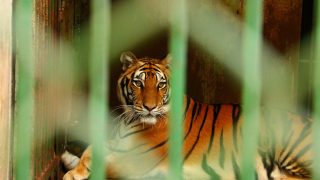
More tigers live in cages in the United States than exist in all the wild. They are just some of the millions of wild animals living in captivity across the country. Some are in aquariums, circuses, theme parks, and roadside zoos, while others live caged at private homes. But few federal laws protect these animals, who may be forced to perform or kept confined in small cages with little to keep their minds occupied and bodies well.
State laws vary considerably, with some states banning private ownership of wild and exotic animals while others have virtually no regulation whatsoever. Captive animals need stronger legal protections, and better enforcement of those protections.
Wild Animals Belong in the Wild
Private Possession: Many wild animals are kept captive in private homes as pets. There is no wild animal “pet” census in the United States, and many states have lax oversight, so any estimates about the population of wild animals in captivity is at best an educated guess.
Among wild animals held as “pets” in the United States are servals, wolves, bears, alligators, snakes, and nonhuman primates of nearly all species. These are wild animals, who have complex, species-specific needs that cannot be satisfied in private homes, are dangerous by nature, and are not domesticated. A largely unregulated trend is the hybrid breeding of wild cats with house cats, with predictably disastrous consequences, including frustrated cats destroying homes, injuring family members, and escaping. Once these private owners inevitably realize that these wild animals are not pets, they contribute a massive demand for already scarce sanctuary space.
It is expensive and difficult to keep wild animals in captivity. These animals invariably live in inhumane conditions and pose a serious threat to public safety.
Trading in Wild Animals: Every year, millions of animals enter the captive wild animal trade. Some of these animals are “surplus” from roadside zoos. Others are captured from their native habitats or come from backyard breeders or the black market. These wild animals are sold at auctions, pet stores, or over the internet.
The trade in wild animals involves tremendous risk and harm at every stage of the process, including depleting wild populations, spreading zoonotic disease, and furthering organized crime.
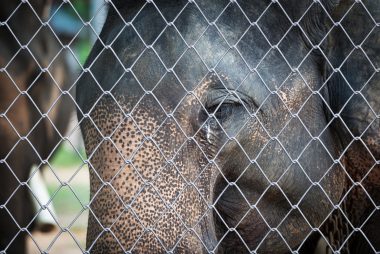
Severe arthritis and foot infections are common in captive elephants due to standing on hard, unnatural surfaces all day without room to roam.
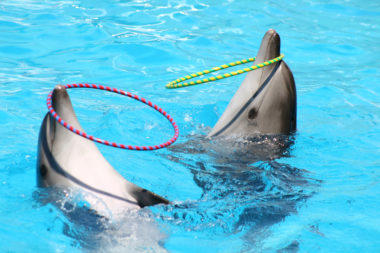
Wild dolphins swim up to 40 miles day with the other members of their pod, while captive dolphins are forced to swim in tiny pools with unfamiliar dolphins day after day.
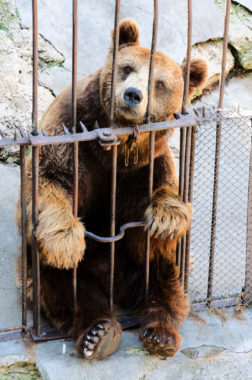
Kept in barren cages rarely larger than 20 by 20 feet, bears in roadside zoos spend their days pacing, sleeping abnormally long periods of time, and bobbing their head – all indications of extreme psychological distress.
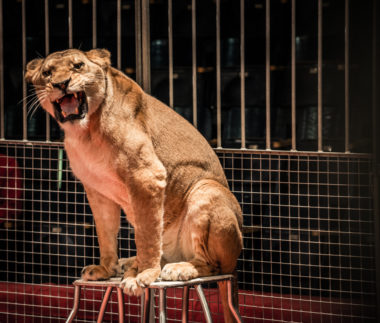
Big cats, such as lions and tigers, used in circuses are forced to live in tiny cages that are transported across the country. Animals are forced to sleep, eat, and defecate in the same small area.
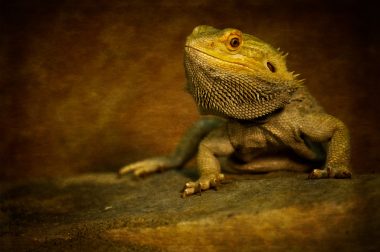
Reptiles have complex UV light and humidity requirements that are rarely met, meaning that many reptiles in roadside zoos are severely dehydrated.
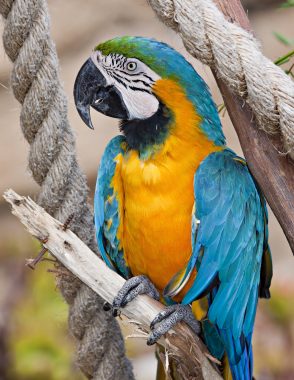
While most birds who are exhibited in places like roadside zoos and circuses are now entitled to protection from the Animal Welfare Act, those protections are so minimal that exhibitors aren't even required to allow birds to fly!
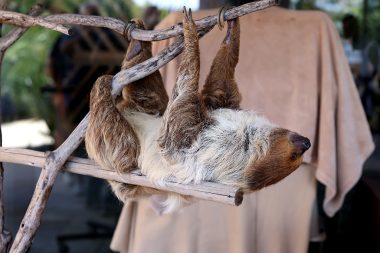
Sloths have such specific health and welfare needs. Additionally, they breed poorly in captivity, so most of the sloths we see being used for public encounters in roadside zoos were taken from the wild homes to be exploited for profit.
Laws That Protect Captive Wildlife
Few federal laws protect the millions of wild animals who live in captivity in aquariums, circuses, theme parks, and roadside zoos in the U.S.
The Animal Welfare Act: The Animal Welfare Act, or AWA, is the primary federal law regulating captive wild animals. Animal exhibitors, including roadside zoos and circuses, are among those who fall under this act.
The AWA only applies to some captive wild animals. The law, adopted by Congress in 1966, protects so-called “warm-blooded” animals who are bred for commercial sale, used in research, transported commercially or publicly exhibited, like in a roadside zoo or circus. Tigers, lions, elephants, bears, and nonhuman primates are all included in this law. But the law excludes protection for rats and mice, farmed animals, and “cold-blooded” animals such as reptiles, amphibians, and fish.
This is only one of the Act’s limitations. Its protections are minimal as well. The AWA establishes only minimal, baseline standards of care for licensing exhibitors. These standards set a low bar and fail to adequately protect animals. For example, the law does not restrict the display or private ownership of captive wild animals or prohibit the use of controversial bullhooks, whips, and other devices commonly used in circuses. For animals in roadside zoos, the AWA sets low requirements as to housing, space and sanitation, and, as is commonly noted, no requirements for mental stimulation for the vast majority of animals under its protection, including highly intelligent and complex species such as elephants, big cats, and bears.
Another serious problem is that the chronically-understaffed USDA conducts inspections infrequently, and enforcement, when it occurs, is inconsistent and lacks meaningful penalties. A common criticism is that the inspectors are often inadequately trained to identify abuse and neglect, let alone violations of their own regulations.
The Convention On International Trade In Endangered Species Of Wild Fauna And Flora (CITES): CITES is an international treaty that regulates the trade of wildlife for nations that are signatories to the treaty. Some 5,800 species of animals are covered by the treaty (along with 30,000 species of plants). CITES does not directly address living conditions for captive animals.
The U.S. became a signatory to CITES in 1975. Today, nearly every country in the world is a member of CITES. The fewer than two dozen non-participants include North Korea, the Federated States of Micronesia, and Turkmenistan.
This treaty is credited with helping foster international cooperation to protect some endangered and vulnerable species. A criticism is that protections are less robust for species that are economically valuable, and that CITES is not as transparent in its decision-making or enforcement as would be ideal.
The Endangered Species Act: The Endangered Species Act, or ESA, is a federal law that protects fish, mammals, birds, and plants listed as threatened or endangered in the U.S. and beyond. The ESA outlines procedures for federal agencies to follow regarding listed species, as well as criminal and civil penalties for violations.
In 2014, the Animal Legal Defense Fund successfully brought a lawsuit under the Endangered Species Act against a roadside zoo called the Cricket Hollow Animal Park, that was mistreating protected animals. This was the first time that the ESA has successfully been used to protect captive wild animals. In 2018, the Eighth Circuit issued a unanimous decision in Cricket Hollow’s appeal of that case, finding that it can be a violation of the Endangered Species Act when captive animals aren’t given proper care.
In several cases, animals held in poor conditions at roadside zoos have been transferred to reputable sanctuaries, after the Animal Legal Defense Fund brought lawsuits under the Endangered Species Act.
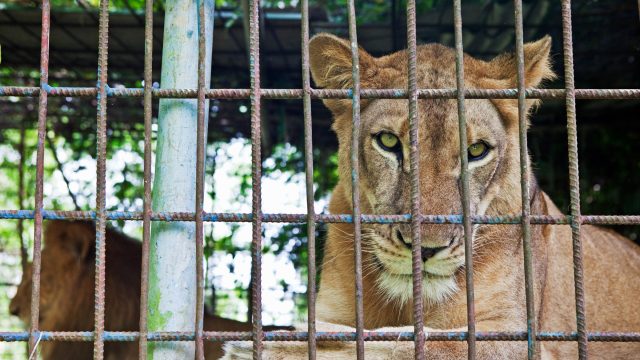
Thanks to the Big Cat Public Safety Act, numbers of big cats in roadside zoos are finally declining instead of growing!
Big Cat Public Safety Act: This law, enacted in 2022, is helping end the rampant abuse of tigers and other big cats in captivity. It bans the private possession of big cats and makes it illegal for exhibitors to allow direct contact between the public and most big cat cubs.
Allowing people to maintain big cats in their homes not only harms animals, it threatens public safety. Lions, tigers, and other big cats are powerful apex predators who can easily kill or severely injure humans. Private ownership of big cats endangered those living in surrounding neighborhoods, as well as first responders who are ill-equipped to handle situations where an animal has escaped. Furthermore, it fueled the wild “pet” trade, creating a financial incentive for people to capture big cats in the wild and breed them for the purpose of selling the cubs.
State And Local Laws: Strong state and local laws have historically been a useful way to protect exotic and wild animals. There is considerable variation from state to state and among cities and counties as to how much legal protection is offered to captive wild animals.
Here are some of the major ways that these jurisdictions are protecting wild captive animals under the law:
Restricting Private Parties From Keeping Wild Animals: Some states ban the private possession of wild and exotic animals. Others allow private parties to keep animals like bears or primates with a permit. Fewer states are allowing residents to keep captive wild animals without a permit. Alabama, North Carolina, Nevada, and Wisconsin are the only four states that have no bans of any kind.
In states without sufficient regulation, some local jurisdictions adopt ordinances that ban or restrict the display of captive wild animals.
Models For Improvement And What You Can Do To Help
With increased awareness about the cruelty inherent in keeping wild animals in cages, more and more jurisdictions are enacting legal protections. These laws help the animals and also humans, since wild animals in captivity present a serious public safety risk.
The state and local laws protecting wild animals in captivity are spreading. We have good models of captive wild animal protection laws outside of this country as well.
The United Kingdom, for example, phased out all traveling circuses featuring wild animal performances in 2019. There are dozens of other countries around the world with similar prohibitions, including Austria, Greece, Israel, Mexico, Peru, and Singapore. India bans the keeping of elephants in circuses and zoos.
Your voice is needed, so that captive wild animals in the United States, and elsewhere, are better protected.
- Visit animal sanctuaries accredited by the Global Federation of Animal Sanctuaries instead of roadside zoos, psuedo-sanctuaries, marine parks, or circuses. Boycott businesses that profit from cruelty to animals.
- Help inform others by writing letters to your local newspapers and posting to social media.
- Tell lawmakers you support animal-friendly legislation and bans on using animals in entertainment.
Related Cases
-
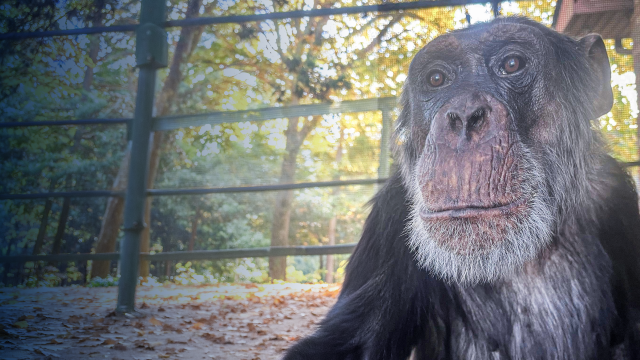
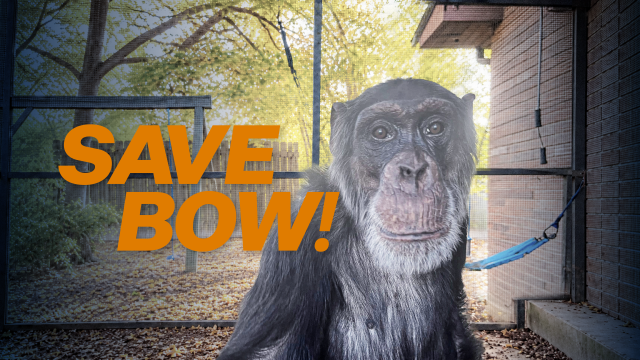
Complaint Urges Federal Officials to Confiscate the Last Remaining Solitary Pet Chimpanzee in U.S.
Submitted complaint to the USDA on October 20, 2026
-
Urging FWS Not to Rescind Regulatory Definition of ‘Harm’ Under the Endangered Species Act
Submitted comments against proposed rule on May 19, 2025
Looking for case and legal resources? View Resources
See MoreRelated News

-
Q&A: ALDF’s Brittany Peet Talks Primate Protection
ALDF Transparency and Regulatory Affairs Program Director Brittany Peet has devoted her career to helping nonhuman primates and other wild creatures kept in inhumane captivity, such as ill-equipped human homes and cruel roadside zoos. (If she looks…
October 20, 2026 Article -
The Last Solitary ‘Pet’ Chimpanzee in the U.S. Deserves Sanctuary
For his first 24 years, life has not been kind to Bow the chimpanzee. -
From Peril to Sanctuary: Toby the Chimpanzee’s Story
Toby spent more than 30 years without ever seeing another chimpanzee. Here's how he found a fresh start — and a happy new sanctuary home.