The Tragedy of Miranda’s Rescue and How we Prevent it from Happening Again
In the northernmost region of California, a gruesome discovery has been made: the mass grave of over 100 dogs, with initial forensic reports showing a vast majority with gunshot wounds to the head. The horror is only amplified when you learn this happened at a dog rescue facility, a place where the expectation is that dogs will be safe and protected from harm. Like everyone, I am heartbroken by this news. But I’m not surprised. I work each day to ensure justice for animal victims by assisting with animal cruelty criminal investigations and prosecutions around the country. And in fact, my Animal Legal Defense Fund (ALDF) colleagues are actively working with authorities on this case. So I know from experience that the other added tragedy here is that cases like this happen far too often.
That brings us to the question everyone is asking: “How could this happen?” This specific case of Miranda’s Rescue in Humboldt County, CA, is in its very early stages, so it’s premature to offer any assessment of what will happen next. But it’s worth taking a moment to look at the broader issues at play that can lead to similar types of situations.
The first thing you need to know about the dog rescue industry is that it is largely made up of a well-meaning community of people who love and want to save animals. The second thing you need to know is that in many states, it is largely unregulated, void of baseline standards, regular inspections, and other safeguards that could be put in place to ensure proper care and treatment. And that enables bad actors to take advantage of the system, taking payments for dog care and adoptions while creating the false impression of safety – in other words, fraud, and worse, animal abuse.
California is like many other states in that there are more animals in shelters than adoptive homes. To address that issue, many shelters participate in transfer programs that move adoptable animals to shelters or rescues where there is a better probability for adoption, as well as more space and resources. The biggest challenge many shelters, and particularly municipal shelters, face is a lack of space when the incoming animals exceed the capacity of the physical shelter. Transfer programs are popular and have driven down euthanasia numbers across the country with great success, but also open up opportunities for bad actor rescues to exploit animals and shelters for profits.
We see this in our work daily. All across the nation, there are cases of animal rescue operators being accused or charged with fraud and mistreatment. In 2026, a self-proclaimed animal rescue owner was charged with aggravated animal cruelty in Citrus County, Florida, after investigators found multiple dead animals on her property called Hess Haven. In 2025, the owner of an animal rescue business in Columbia County, Oregon, called Woofin Palooza, was “sentenced to federal prison…for her role in a conspiracy to defraud customers seeking to adopt pets illegally and dispensing prescription animal drugs without a lawful order of a veterinarian.” In 2023, the Attorney General’s Office in Washington State filed 48 criminal charges of animal cruelty against those involved with Neo’s Nation Animal Foundation. The Foundation managed Tri Cities Animal Shelter, and an investigation revealed the facility was keeping animals in conditions that left them malnourished and severely ill. ALDF works to stop this from the start through stronger state laws and policies, and also works to ensure strong legal cases and prosecutions when criminal animal cruelty does occur.
At the state level, while there have been many gains in animal criminal law in recent decades, there are still significant gaps. In 2013, ALDF worked with a coalition to write and push for Senate Bill 6 in Oregon, a new law that strengthened a number of animal cruelty protections, including mandating the regulation of animal rescue entities, and requiring licensure and regular inspections of those facilities. The impetus for this bill was another sham rescue where 149 starving and imperiled dogs were seized by authorities in Brooks, Oregon, leading to animal neglect charges against the owner. There is now renewed interest by California legislators to explore passing stronger protections, given the situation at Miranda’s Rescue.
Of course, laws are only as good as their enforcement. And that is where law enforcement officials, prosecutors, animal control, trained veterinary forensics experts, and other crime scene analysis experts come in. These public officials all need to have the resources to pursue criminal animal cruelty cases. But they rarely do.
A large part of my team’s work within ALDF’s Criminal Justice Program is to support local stakeholders, giving them the tools, training, and resources they need to work across the animal care, law enforcement, and legal system, so that they can bring justice to animals who have been mistreated. For example, we are collaborating with local and federal authorities to support the investigation into Miranda’s Rescue.
Recognizing the importance of bringing key partners together in cruelty case response, a few years ago, we kickstarted our Collaborative Response Project in key locations across the U.S. to bring this type of shared training and resources to bear. And it works. In McHenry County, Illinois, hundreds of animals were protected in the program’s pilot year alone. Law enforcement, veterinarians, animal control officers, nonprofit partners, and prosecutors began working together — with shared training, shared tools, and shared commitment. After its success, the project expanded to Clark County, Washington, where it completed its second year of lifesaving impact and sought accountability when animals were harmed.
In one case in Battle Ground, Washington, ALDF facilitated the assistance of a forensic veterinarian whose findings were instrumental in bringing multiple animal cruelty charges against the owner of nine dogs that were left without food or water in a garage. Five of the dogs were already deceased. In Vancouver, Washington, a veterinarian documented the condition of 10 deceased cats that contributed to charges of first-degree animal cruelty. Police and Animal Control in Clark County worked in partnership to remove eight French bulldogs and a cane corso living in poor conditions inside an RV. After a deceased kitten was found in a dumpster, Clark County Animal Control and Vancouver police executed a search and conducted advanced DNA testing to uncover more victims and charge the owner with first-degree animal cruelty. It’s the integration of these teams – law enforcement, animal control, forensic veterinarians – all working together that allowed these cases to move forward successfully. We have similar projects ramping up in Arizona and Montana this year.
And finally, it’s really important for people to be aware of the source of their animals. Without proper legal standards for operating dog rescue facilities, please do what you can to get to know your local rescue. It’s critical to ensure that rescues are transparent about their policies and mission and that they have a current and valid status as a nonprofit by verifying their registration with state’s charity regulator. The public can ask for references from recent adopters, veterinarians, and volunteers to get a better sense of whether a rescue is trustworthy and to see whether animals receive veterinary care, spay/neuter, enrichment, and behavior support. It’s important for the public to understand that legitimate rescues welcome questions and address concerns. The reality is that most rescues run on limited resources and depend on volunteers for many of their operations, but they should be accountable, honest, work within their capacity for care, and focus on animal welfare over profit.
It’s part of my life’s work, here at ALDF, to prevent cruelty to animals. But ALDF cannot do it alone. I hope the news out of Humboldt County serves as a clarion call for all animal lovers. Be aware. Ask the right questions of dog facilities. Call on your policymakers to pass laws to protect dogs within this system. And support efforts to enforce the law when it’s broken.
-
Emily Lewis
Managing Attorney

Focus Area
How We Work
Related
-
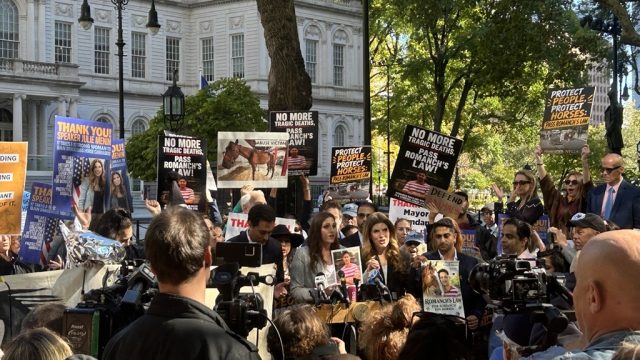
NYC Council Passes Romanch’s Law in Historic Vote to End Horse-Drawn Carriages by 2028
The bill will responsibly phase out the horse drawn cab industry to make NYC safer for allOctober 22, 2026 Press Release -
ALDF Announces Caitlin Hawks as New Executive Director
The Animal Legal Defense Fund today announced Caitlin Hawks as its new executive director.October 21, 2026 Press Release -
Group Seeks Federal Action to Protect the Last Remaining Solitary Pet Chimpanzee in the U.S.
Bow, an endangered chimpanzee, is being held in solitary confinement in violation of federal lawOctober 20, 2026 Press Release