The Last Solitary ‘Pet’ Chimpanzee in the U.S. Deserves Sanctuary
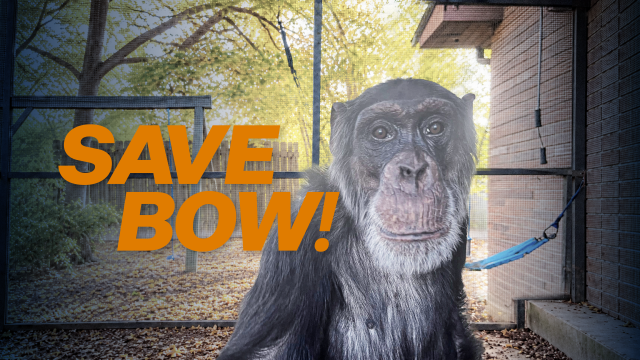
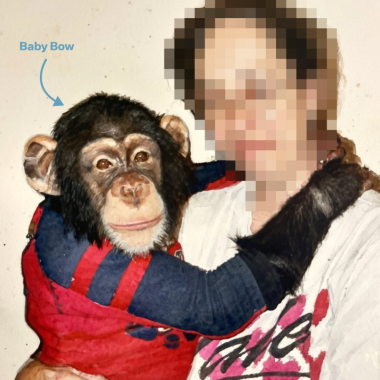
Taken from his mother as an infant. Never seeing another member of his own species again for decades. Exploited online for money and clout. For his first 24 years, life has not been kind to Bow the chimpanzee.
Today, with every other known “pet” chimpanzee in private homes accounted for, experts believe that only one continues to be held as a solitary pet in the U.S.: Bow. And the prospect of rescue is in reach.
The Animal Legal Defense Fund (ALDF) is working to make the rest of his life happier, healthier, safer, and infinitely more fulfilling — at a true sanctuary, with his fellow chimpanzees.
We need your help to make it happen.
Why Bow’s Living Conditions Violate the Animal Welfare Act
When Bow was separated from his mother as a baby, he was sold to an “owner,” Aya Katz, who raised him in her Missouri home. Katz and a handful of other humans have apparently been Bow’s only social outlet ever since — for 24 years.

“ Bow’s plight is a cruel reminder of a once-rampant industry fueled by chimpanzee breeders who tore infant chimpanzees from their frantic mothers and sold them for tens of thousands of dollars to anyone willing to pay. Even if the human owner keeping Bow captive is well intentioned, she cannot replicate the intricate family structures that chimpanzees need to flourish or contend with their need for constant stimulation.”
ALDF Transparency and Regulatory Affairs Program Director Brittany PeetKatz extensively shares content about Bow online, including through a monetized, member-exclusive YouTube channel (more on that later). This content has provided a visual record of how Bow lives. Simply put, his conditions are deeply inhumane.
Concrete flooring appears to have taken its toll on Bow; recent videos show him bearing weight unusually, with abnormal posture including his toes curling under. Expert veterinary consultation suggests that prolonged exposure to hard surfaces may have contributed to this unusual posture, and indicates that Bow is likely in pain.

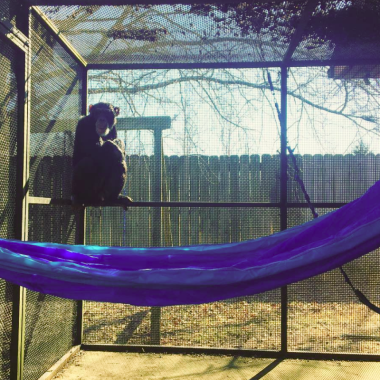
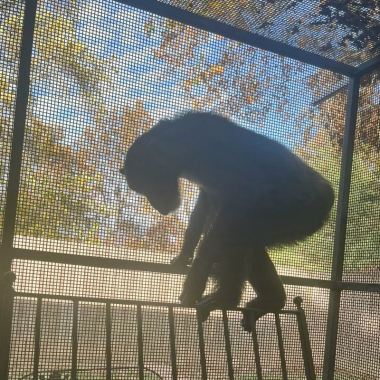
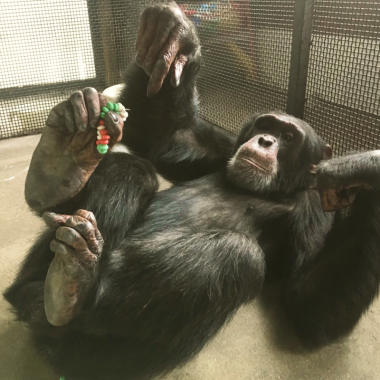
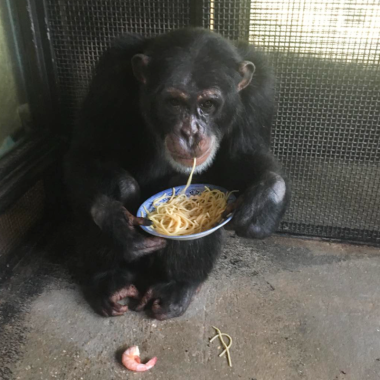
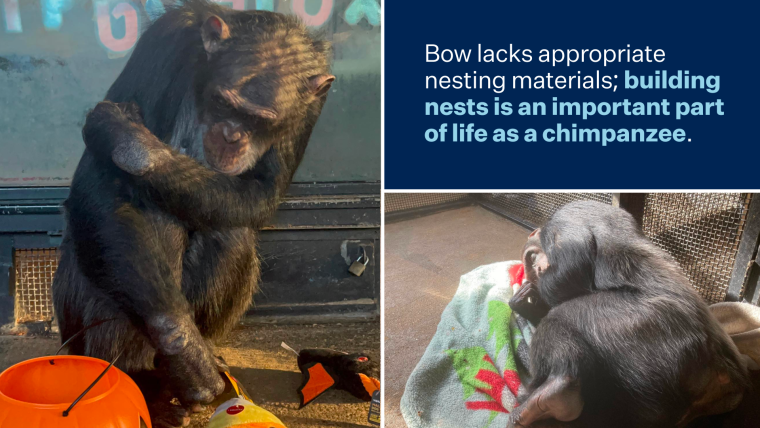
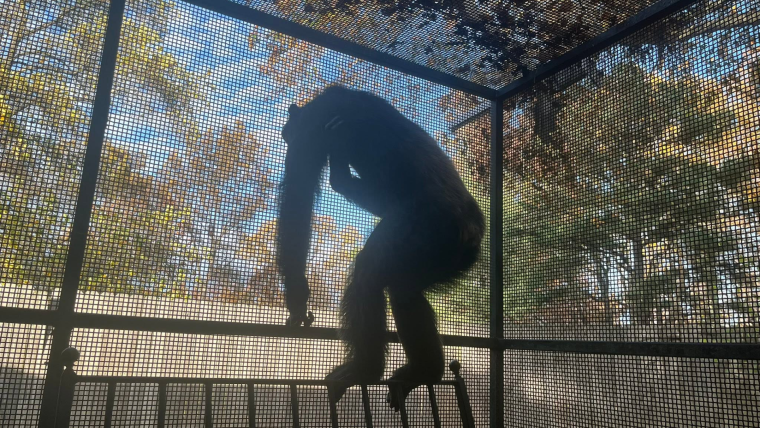
Bow’s living conditions are notably lacking in other ways as well. In the wild (and in appropriate sanctuary environments), chimpanzees spend much of their time climbing or resting in elevated perches. Bow has little vertical space in which to climb or perch. He is also being deprived of meaningful enrichment to keep his bright mind active; varied and complex enrichment activities are a hallmark of reputable primate sanctuaries. He even lacks appropriate nesting materials; building nests is an important part of life as a chimpanzee. (A recently rescued chimpanzee, Toby, had spent nearly his entire life in an Indiana garage. When he was transported to a sanctuary at long last earlier this year, one of his first orders of business was to build a nest out of soft blankets in an outdoor section of his quarantine enclosure, where he took full advantage of the opportunity to spend the night outside.)
Why Solitary Confinement Harms Chimpanzees
Solitary confinement is commonly viewed as an extreme, even torturous, means of housing human prison inmates. What, then, should we call a form of confinement for an individual who’s been accused of no wrongdoing, but nonetheless has been deprived of any exposure to their own species for decades?
Simply put, it’s cruel— and research not only shows that, but a string of real-world tragedies unfortunately back it up.
“ Bow has been socially isolated from other chimpanzees for approximately 24 years. This prolonged deprivation is extreme and incompatible with the [Animal Welfare Act’s] requirement to promote psychological well-being.”
Dr. Stacy Lopresti-Goodman, PhD, behavioral scientist and Animal Law Education and Scholarship Program DirectorYou’re likely already familiar with some captive chimpanzees whose stories have made headlines — names like Travis (a Connecticut chimpanzee who was raised like a human child before ultimately attacking a friend of his owner, causing catastrophic injuries, before he was stabbed and fatally shot) and Buck (an Oregon chimpanzee who suffered a similarly tragic fate).
Like Travis, Buck, and others, Bow was denied the opportunity to grow up with his mother; in the wild, young chimpanzees are highly dependent on their mothers and remain with them for years. And like these other chimpanzees forced to live as pets, Bow has been deprived of any contact with others of his own species since he was an infant.
Early maternal separation and prolonged isolation have been shown to result in long-term psychological trauma in chimpanzees. Documented symptoms can strongly resemble post-traumatic stress disorder (PTSD) and complex post-traumatic stress disorder (CPTSD) in humans.
The stress caused by solitary housing not only harms Bow himself, but also ramps up the safety risk he poses to the humans around him — not just to Katz, but to the broader public as well.
For all involved, it’s well past time for Bow to have a better life, including the opportunity to live among other chimpanzees.
ALDF’s Federal Complaint to the USDA and Fish & Wildlife Service
ALDF has worked for decades to protect wild animals from inhumane captivity.
To protect Bow, ALDF submitted an official complaint to the U.S. Department of Agriculture (USDA), U.S. Fish and Wildlife Service (USFWS), and U.S. Department of Justice in October 2026, urging the agencies to take action by requiring Bow to be relocated to an accredited chimpanzee sanctuary.
The USDA administers the Animal Welfare Act, and the USFWS administers the Endangered Species Act for land-animal species protected by the law. Since 2015, that has included captive chimpanzees; prior to that, a so-called “split listing” protected only wild chimpanzees under the Endangered Species Act, but not those in captivity. ALDF was among a group of advocates and organizations that successfully campaigned for the federal government to end the split listing and protect all chimpanzees. The expansion of protections under the Endangered Species Act is considered a primary reason for the decline in numbers of pet chimpanzees: The listing change not only effectively ended the trade in chimpanzee pets, but also opened the door to Endangered Species Act lawsuits filed on behalf of chimpanzees already being kept in inhumane captivity.
ALDF’s complaint comes after the USDA cited Bow’s owner for illegally exhibiting him on social media without a license to exhibit animals under the Animal Welfare Act. Katz has not obtained an exhibitor’s license in the three years since this citation, and she continues to illegally exhibit Bow online in violation of the law. Unfortunately, the USDA has thus far taken no further action — making ALDF’s action critical.
Our complaint urges the USDA to do its job to protect Bow based on his continued unlicensed exhibition, and urges the USFWS to properly protect him under the Endangered Species Act. We argue that keeping him in solitary confinement constitutes harassment of an endangered animal under the law.
The Captive Primate Safety Act: Ending the Pet Chimpanzee Trade for Good
Bow’s transfer to a sanctuary would be the culmination of decades of effort by advocates, primatologists, and veterinarians who have worked tirelessly to close a cruel chapter and ensure that no other chimpanzee is ever held as a solitary pet in the U.S.
It is vital that we protect every primate from the cruelty of being held in private homes that cannot meet their complex needs. There are untold thousands of captive primates, from multiple species, being held as pets in the U.S. today. We’re championing a federal bill called the Captive Primate Safety Act, which would end the pet trade in primates from chimps to capuchins and beyond.
Focus Area
Related
-
Group Seeks Federal Action to Protect the Last Remaining Solitary Pet Chimpanzee in the U.S.
Bow, an endangered chimpanzee, is being held in solitary confinement in violation of federal lawOctober 20, 2026 Press Release -
Groups File Opening Briefs in LCFS Biogas Lawsuit
ALDF, as part of a coalition, filed an opening brief in a case to force California’s Air Resources Board to reform its Low Carbon Fuel Standard.September 29, 2026 Press Release -
Cascade County, Montana, Selected for Animal Cruelty Response and Prevention Program
The launch of the program includes a community survey to help the program address animal cruelty and support abuse prevention in Cascade CountySeptember 15, 2026 Press Release