
The Harms of High-Speed Slaughter
Fighting the federal government’s efforts to weaken food safety standards at slaughterhouses
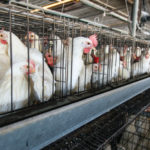
The U.S. Department of Agriculture (USDA) is proposing to further deregulate farmed animal slaughterhouses by allowing them to operate their slaughter lines at even more dangerously high speeds. The speed at which these facilities stun, kill, and butcher animals has a direct impact on animal welfare, food safety, public health, worker safety, and pollution.
The USDA sets maximum line speeds for slaughterhouses. But for decades it has, in response to industry pressure, allowed faster and faster line speeds. The newest USDA proposal would cut even more corners by raising the maximum line speed for chicken and turkey slaughterhouses even further and eliminating line speed regulation in pig slaughterhouses altogether.
If finalized, the USDA’s proposal would further increase animal suffering and slaughterhouse pollution while also further imperiling consumers, communities, and workers.
Increased Animal Suffering
No one wants animals to suffer, including farmed animals. But higher line speeds will inevitably lead to more animal harm. Line speeds are already so fast that it is impossible for workers to handle animals humanely and ensure effective stunning. Even faster line speeds will increase the risk that animals are conscious when they are slaughtered.
Specifically, the new proposal would allow the following:
- Chicken slaughterhouses would be able to increase kill line speeds from 140 birds per minute to 175 — a 25 percent increase.
- Turkey slaughterhouses would be able to accelerate from 55 birds per minute to 60.
- Pig slaughterhouses currently have a maximum line speed limit of 1,106 pigs per hour, but under the new rule, there will be no speed limit.
If finalized, the rules will apply to 94 percent of chickens slaughtered, 79 percent of turkeys slaughtered, and 64 percent of pigs slaughtered.
Threats to Food Safety
The government has a legal obligation to regulate slaughterhouses to ensure food safety. Instead, by allowing faster line speeds, the government is increasing the likelihood that chicken, turkey, and pig products will be contaminated and unsafe to eat.
This creates multiple risks to our health:
- The meat could contain fecal matter and/or bacteria, which could cause food poisoning.
- The inspectors could miss signs of disease.
- The meat could be contaminated with foreign objects, like glass, plastic, or rubber, that shouldn’t be in our food.
Risk to Workers
Slaughterhouse workers notoriously have one of the most dangerous jobs in the country. Increasing line speeds will put them at even greater risk of injury.
Faster line speeds mean slaughterhouse workers are at greater risk of severe cuts – even amputations. And constant, rapid, repetitive motions increase the likelihood of musculoskeletal strains and disorders.
The animal agriculture industry has a documented history of discouraging slaughterhouse workers, who tend to be members of economically and socially marginalized communities, from reporting injuries or seeking medical treatment. This can lead to workers going without treatment for injuries sustained on the job.
Increased Harm to the Environment and Climate
Faster line speeds result in more production, and that has a ripple effect across the factory farm industry. It creates more pollution — not just at slaughterhouses, but at every step of production. Here’s what that means:
- Faster line speeds would mean more water and air pollution from slaughterhouses.
- Expansion and consolidation of factory farming to produce even more meat.
- Factory farms are already notorious for their water and air pollution. The sewage and waste runoff contaminate drinking water resources as well as neighboring watersheds, streams, and rivers. The air pollution is noxious and dangerous to surrounding communities and fuels the climate crisis.
- More meat production also means more pollution from the packaging, transporting, and distribution of the product across the supply chain.
Faster line speeds are bad for people, bad for animals, and bad for our planet as a whole.
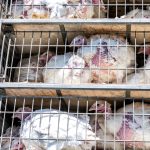
Petition: Urge USDA to Stop Its Plans to Increase Slaughterhouse Line Speeds
Sign the petition to say NO to the USDA’s dangerous plans to increase slaughterhouse line speeds. Your name, along with thousands of other supporters, will be added to ALDF’s official comments to these proposed government regulations.