New York City’s Horse Carriage Ban – 20+ Years in the Making
After decades of advocacy, horse carriages will finally be banned in New York City. This is a long overdue and hard-won victory for animal and public safety advocates, including the Animal Legal Defense Fund (ALDF).
Anyone who knows horses know that the sights and sounds of Midtown Manhattan – sirens, crowds, construction, and traffic – is not the optimal environment for animals with an instinctive flight response. Even well-trained horses can become frightened by unexpected stimuli and bolt, creating risks for passengers, pedestrians, cyclists, motorists, drivers, and the horses themselves. Unsurprisingly, the horse carriage industry has faced a troubling pattern of accidents, injuries, and deaths. In the past thirteen months alone, Central Park has seen eight separate horse-related incidents, including runaway carriages, collisions, injury, and the loss of life.
But while the risks and impacts have long been known, a practice that’s more than 100 years old doesn’t end easily. So, for nearly 20 years, ALDF pressed on every front: lawsuits, legislation, public engagement and promotional campaigns, expert scientific testimony, and coalition partnerships. ALDF never let up, and for the horses that will never endure this industry’s cruelty, it was all worth it.
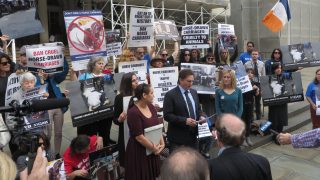
We first joined the effort as part of one of the earliest coalition campaigns to ban horse carriages. In 2012, we took it a step further by filing public records requests with the NYPD to gain a clearer sense of the scale of accidents and injuries associated with the industry. After a successful Freedom of Information Act (FOIA) lawsuit against the NYPD, we were able provide public testimony in 2014 detailing the findings, which revealed that New York City carriage drivers had committed more than a dozen “hit & runs” over the previous five years. Records showed that children, cyclists, pedestrians, carriage drivers, passengers, and NYPD officers had all been physically injured by accidents involving New York’s horse carriages.
As the fight continued, we sought new ways to chip away at the industry’s harm and create some measure of protection for horses. In 2019, ALDF helped pass the Carriage Horse Heat Relief Bill. This law prohibits horses from being worked when the heat index reaches 90 degrees or above. Despite this step, horses were still suffering. There have been multiple instances of horses being overworked in the heat — including the high profile 2022 incident in which a horse named Ryder collapsed on 9th Avenue while being forced to pull a carriage in the brutal summer sun. He was mercilessly whipped as the driver yelled for him to get back up, all of which was captured on video. Sadly, Ryder never recovered and died on Oct 17th.
That tragedy put a new spotlight on the issue. To generate even greater visibility, ALDF partnered with 25 actors, artists, and musicians, including Billie Eilish, Rooney and Kate Mara, Joaquin Phoenix, Ricky Gervais, Marisa Tomei, Hilary Swank, and Christopher Walken on a public letter of support for a ban. This brought widespread national attention to the issue and galvanized the public in a new way. In 2022, ALDF and Voters for Animal Rights released polling that reinforced that shift in public sentiment: 71% of New York City voters supported a ban on horse-drawn carriages in the city.
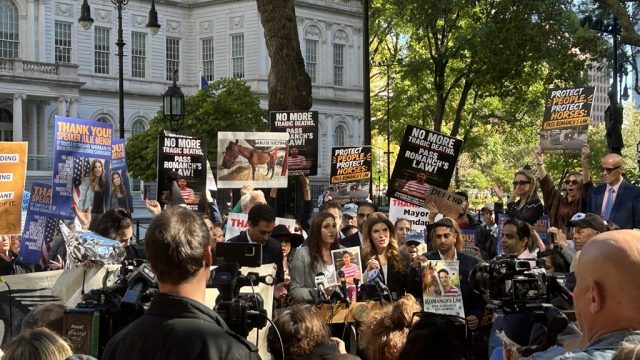
But despite the years of advocacy, the horse carriage industry remained entrenched in city politics and legislation still languished – until this year. Another series of accidents, including the horrific and tragic death of a young man named Romanch Mahajan, brought a renewed sense of urgency to this ever-present danger. And city leaders began to push for a better way. This summer, ALDF attended a rally on the steps of City Hall and testified in support of Intro 943, now rightfully known as Romanch’s Law. ALDF also brought an equine veterinarian to testify as an expert scientific witness. The veterinarian reinforced what we all know: New York City is not a safe environment for horses, and it puts people at risk. We rallied our supporters and the public once again. And this time, finally, we won.
Romanch’s Law will compassionately and thoughtfully phase out New York City’s horse carriage industry. The full ban will take effect in 2028, providing the industry with important workforce support, including a workforce development program for drivers and other workers engaged in the horse carriage industry that will help facilitate their transition to other fields of employment. It will also provide critical protections for the horses, ensuring they cannot be sold for labor or slaughter, and result in the ultimate transfer of approximately 160 horses to safe environments. The bill is a balanced approach to reform and should serve as a model to other cities that still allow this industry.
The animal welfare community is committed to seeing this through and is prepared to provide lifelong homes for the horses with over 30 sanctuaries and rescues willing to provide sanctuary and proper care. The Animal Legal Defense Fund stands ready to contribute to the costs of the horses’ safe transfers to their new homes.
None of this would have been possible without the committed leadership of Council Speaker Julie Menin and bill sponsor Council Member Christopher Marte, along with a majority of city council members who cosponsored Romanch’s Law. Mayor Mamdani has publicly noted his support and is expected to sign this bill into law very soon.
I’m also grateful to all of our coalition partners, as well as my ALDF colleagues. Reflecting back on the decades of work, I’m struck by the tenacity, legal skills, policy expertise, scientific analysis, and good old-fashioned advocacy and organizing we were able to bring to bear for this fight. I count myself lucky to work at a place that has such a strong mix of expertise and skills, as well as the commitment to stay in the fight for as long as it takes. It certainly reminds me there’s a fortitude and resilience to animal protection, and you need that in this line of work.
New York may not have been the first city to ban horse carriages. Bans already exist everywhere from Chicago, Philadelphia, and Las Vegas to Paris, Barcelona and Shanghai. But New York will forever be a trendsetter. So I hope and expect New York’s ban will serve as a galvanizing moment and build momentum toward additional bans in cities where the horse carriage industry still persists. Thus, while I savor this victory, ALDF’s work carries on. We’ll keep at it until we close the door, permanently, on this dangerous industry. We’ll keep at it in order to protect the public and the horses.
-
Kathleen Schatzmann
Strategic Legislative Affairs Manager


How We Work
Issues
Related
-
NYC Council Passes Romanch’s Law in Historic Vote to End Horse-Drawn Carriages by 2028
The bill will responsibly phase out the horse drawn cab industry to make NYC safer for allOctober 22, 2026 Press Release -
Oregon Supreme Court Denies Petition to Review Case Involving Lawsuit on Behalf of Abused Horse
Lawsuit sheds light on the need to recognize legal rights for animal cruelty victims.March 7, 2023 Press Release -
Amicus Briefs Filed Urging Oregon Supreme Court to Hear Lawsuit on Behalf of Abused Horse
The amicus briefs from notable experts including Harvard University's Laurence H. Tribe filed in support of neglected horse’s lawsuit against his former abuserJanuary 9, 2023 Press Release