
Constitutional Court of Colombia Upholds—and Expands—Bullfighting Ban
By Nicole Pallotta, PhD, Senior Policy Program Manager
[T]he cultural transformation adopted through the prohibition of bullfighting … is constitutional, as it pursues a constitutionally important goal, which is based on the actual materialization of the constitutional mandate of animal protection and welfare.
— Constitutional Court of Colombia, Sentencia C-374/251
Introduction
In September 2025, the Constitutional Court of Colombia not only upheld a nationwide ban on bullfighting but also struck down exemptions for cockfighting and related events where cattle are injured and killed for sport.2
With this decision, Colombia joins the growing list of countries that have prohibited bullfighting on animal cruelty grounds, rejecting long-standing arguments about the sacrosanctity of cultural tradition.
On the contrary, the Court emphasized the goal of “cultural transformation,” characterized by new rules that “exclude behaviors that are no longer tolerable … because they occur in the context of violence and arbitrary aggression against other sentient beings.”
Background
Colombia’s bullfighting ban was the culmination of a decades-long campaign by animal rights advocates. The campaign gained crucial support in 2022 with the election of President Gustavo Petro, who had long been an opponent of bullfighting. As mayor of Bogotá, Colombia’s capital and largest city, Petro banned bullfights in the city-owned Plaza de Toros La Santamaría in 2012.
However, the Bogotá ban was overturned by the Constitutional Court of Colombia in 2014, which cited the significance of bullfighting in the national culture and ruled the city had exceeded its authority in enacting a ban.3 The Court’s reasoning mirrored that of bullfighting proponents, who have continually argued that bullfights are an integral part of Colombia’s cultural heritage and therefore must be preserved.
“No Mas Olé”
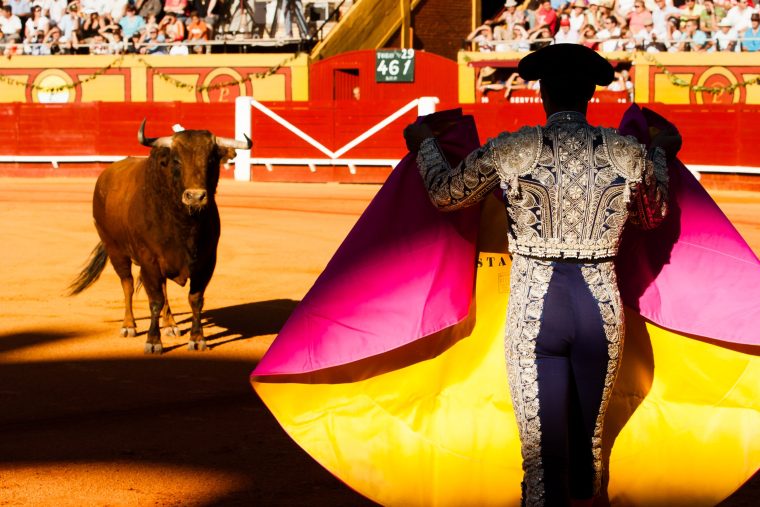
The nationwide bullfighting ban—Law 2385, also known as the “No Mas Olé” Law— was overwhelmingly approved by the Colombian Congress in 2024. Upon signing the bill, President Petro directly addressed arguments about cultural heritage, declaring: “We cannot tell the world that killing living and sentient beings for entertainment is culture.”4
The law requires bullfighting to be phased out completely by 2027, after which publicly owned bullrings will be transformed into venues for arts, education, sports, and other cultural events. The ban also provides that “the necessary measures will be taken to facilitate the transition of people who depend on these activities to other economic and/or work activities.”
Although exceptions were expressly carved out for cockfighting, corralejas, and bull roping in the original legislation, when the ban was challenged on constitutional grounds these exemptions also came under scrutiny by the Court.5
Lawsuits Challenging the Bullfighting Ban
In two lawsuits before the Constitutional Court, plaintiffs argued that Law 2385 violated fundamental rights to “cultural diversity,” along with the free development of personality, freedom of expression, and private property. In reaching its decision, the Court weighed two distinct constitutional mandates: 1) the protection and welfare of animals, and 2) the protection of cultural diversity.
In considering the culture question, the Court reviewed “the jurisprudence related to bullfighting activities … as cultural manifestations.” However, the Court cautioned that these previous rulings were “decided in a different regulatory and jurisprudential context.” In other words, the law evolves.
The Court proceeded to note the ways legal structures in Colombia and worldwide have developed in recent years to give greater weight to animal protection concerns:
Unlike the previous cases, in the current situation: (i) the legislature has enacted several laws that promote the protection of animals against mistreatment and cruelty, and seek to achieve their greater well-being; (ii) this is coupled with international developments recognizing the intrinsic value of animals and their reclassification within the scope of legal protection. Furthermore, (iii) constitutional jurisprudence, in recent years, has interpreted more thoroughly the scope of the State’s obligations regarding the protection of animals and their relationship with human beings.
These observations reflect references elsewhere in the ruling to a “living” Constitution, whereby constitutional mandates are not immutable but instead can incorporate new social norms:
For this Court, societies are not static, nor are the constitutional mandates that govern them. These mandates allow, precisely, for the incorporation of new values and principles into their interpretation [which] are consistent with the tenets of a society that establishes new rules of conduct and seeks to exclude behaviors that are no longer tolerable, among other reasons, because they occur in the context of violence and arbitrary aggression against other sentient beings.
In view of this updated context, the Court not only found the bullfighting ban to be constitutional, but also struck down the exemptions for cockfights, bull roping, and corralejas.
Thus, in a somewhat ironic twist, the legal challenge to Colombia’s ban on bullfights resulted in a more robust ban, which not only prohibits bullfights but also similar entertainment spectacles involving animal abuse.
Analysis
The Court’s ruling signifies a growing understanding that animal cruelty cloaked in the guise of entertainment and tradition can no longer be justified within a cultural or a legal framework.
Promoting “Cultural Transformation”
Bullfights have a long history in Colombia that can be traced to Spanish Colonial times. However, in recent decades these events, in which bulls are tortured and eventually killed to entertain crowds of spectators, have come under increasing scrutiny as social norms have evolved to weigh animal rights concerns more heavily.
During congressional debates on the bullfighting ban, lawmakers argued that animal cruelty cannot be justified by tradition. These arguments emphasized the social changes that have occurred in the ten years between the Constitutional Court ruling that overturned the capital’s citywide ban and the current decision upholding a national ban.
For example, Congressman Juan Carlos Losad said: “We do not believe that an expression of torture and barbarism can be considered cultural.”6 Congressman Alejandro Garcia likewise commented: “We are prioritizing the welfare and defense of all animals. To the whole world, we say Colombia is in a process of cultural transformation, where all beings retain dignity.”7
Framing the issue as one of cultural “transformation” is significant, because cultural “tradition” has been the most common justification for allowing bullfights to continue, and one with which courts have agreed in the past. In upholding the ban, the Constitutional Court reached a similar conclusion about the waning supremacy of cultural tradition:
At this point, it is clear that there is a peaceful consensus, grounded in a universal ethic and enshrined in our living Constitution, regarding the duty not to deliberately cause pain, suffering, or death to another sentient being under the pretext of pleasure or entertainment, even when such an act may have historical connotations of an artistic or cultural nature. [emphasis added]
Thus it is striking that culture—used for decades to justify bullfighting—became the very reason the legislature, and now the Court, determined it must end.
The Court also cited cultural transformation as a reason to extend the ban to the previously exempt activities of cockfighting, bull roping, and corralejas, writing:
[T]hey are activities that, like the prohibited ones, perpetuate a culture of violence against animals and disrupt social harmony. In this vein, the Court considered that cultural transformation must also begin with these types of events, since, under the pretext of generating entertainment, acts of suffering and pain are committed against horses, roosters, and bulls. All of this is contrary to the constitutional mandate of animal protection and welfare, which prohibits arbitrary mistreatment of animals, as well as that motivated by reasons of recreation or pleasure.
The Court’s assertion that a culture of violence against animals disrupts social harmony—coupled with its emphasis on the constitutional mandate for animal protection—is particularly significant. In Colombia, this mandate stems from a constitutional provision protecting the environment, which has been interpreted to include animals in subsequent jurisprudence. This interpretation—elevating animal protection to a national concern—has been reinforced by laws like Ley 1774, which in 2016 modified the Civil Code to classify animals as “sentient beings” rather than “movable objects.”
“Arbitrary Mistreatment”
The Court’s finding that the constitutional mandate of animal protection prohibits “arbitrary mistreatment” contains a common qualification. Words like “arbitrary” and “unnecessary” often appear in court decisions, legislation, and constitutional provisions addressing animal cruelty.
Although commonplace in legal discourse around animal treatment, qualifiers like “arbitrary” and “unnecessary” are socially constructed and easily outweighed by human interests in anthropocentric legal systems. Moreover, prohibiting “arbitrary” or “unnecessary” mistreatment of animals creates an implicit contrast whereby cruelty deemed nonarbitrary or necessary is presumed to be legitimate.
However, the question of necessity is one with which courts are increasingly grappling, and redefining—representing an expanding fissure in what Steven Wise called “the legal wall” that separates humans from other animals.8 Animal cruelty for entertainment has become more culturally contested precisely because the Overton window of what is considered “necessary” has shifted.
The ruling highlights this shift. The Court tacitly recognized that while “cultural heritage” was equated with necessity in the past, the persuasive power of this equation has diminished within developing legal frameworks that value animal protection alongside human traditions. We can hope to see these shifts in other animal law contexts as well.
It is important to note that although the necessity frame has facilitated important changes for animals used in entertainment, it has been an obstacle to advancing protections for farmed animals due to contested and often industry-driven definitions of “necessary” and “arbitrary.”
Conclusion
The Constitutional Court of Colombia’s decision is not only animal-forward but also future-forward. In its relatively concise 3,000 word ruling, the Court repeatedly references cultural transformation, updated legal frameworks, new values and principles, the exclusion of behaviors that are no longer tolerable, and the evolution of constitutional jurisprudence. Thus it highlights the dynamic relationship between law and culture and shows how legal structures adapt—albeit slowly at times—to changing social norms.
Lethal bullfights—in which the bull is either killed in the ring or severely injured and later killed outside the arena—remain legal in some form in Ecuador, France, Mexico, Portugal, Peru, Spain, and Venezuela. 9 In all of these countries, bullfights are a source of social conflict around changing public opinion about animal cruelty and a target of legislative reform. Globally, we can expect to see further progress against animal cruelty as entertainment, consistent with the Constitutional Court of Colombia’s landmark decision.
Further Reading
- Corte Constitucional de Colombia. Sentencia C-374 de 2025. M.P. Miguel Polo Rosero. Disponible en SUIN-Juriscol: https://www.suin-juriscol.gov.co/viewDocument.asp?id=30055540
- Vega, Angie. “Legal Framework of Bullfighting and Societal Context in Colombia.” Animal Legal & Historical Center. Michigan State University College of Law, 2018. https://www.animallaw.info/article/legal-framework-bullfighting-and-societal-context-colombia
Any opinions contained in this article are the personal views of the author. They are not necessarily representative of the opinions or views of the Animal Legal Defense Fund or any clients. This information is presented for informational purposes and does not constitute legal advice.
References
- Corte Constitucional de Colombia, Sentencia C-374/25 (M.P. Miguel Polo Rosero). Available at SUIN-Juriscol: https://www.suin-juriscol.gov.co/viewDocument.asp?id=30055540
- Law No. 2385 of 2024 prohibited bullfighting activities and “the procedures used in these shows that damage the integrity of non-human forms of life.” It also contained a paragraph explicitly naming activities that were excluded: “The prohibition described in this article does not extend to the other daily activities and practices carried out in the national farm industry, nor do they extend to other activities and practices not described in this law. Therefore, activities such as horseback riding, bull roping, corralejas, and cockfights are excluded from the prohibition.” The Constitutional Court struck down these exemptions for bull roping, corralejas (informal bullfighting events involving public participation), and cockfighting.
- Corte Constitucional de Colombia, Sentencia T-296/13 (M.P. Alexei Julio Galvis). Available online: https://www.corteconstitucional.gov.co/relatoria/2013/t-296-13.
- Manuel Rueda, “Colombia’s President Signs Bill to Ban Bullfighting in the South American Country,” Associated Press, July 22, 2024, https://apnews.com/article/colombia-bullfighting-ban-a7b7d0a8f87abef0e79c4eec693af574.
- Josep Freixes, “Corralejas: The Tradition That Escaped Colombia’s Bullfighting Ban,” Colombia One, May 25, 2025, https://colombiaone.com/2025/05/25/colombia-corralejas-bullfighting/.
- Reuters, “Colombia’s Congress Bans Bullfights,” Reuters, May 29, 2024, https://www.reuters.com/world/americas/colombias-congress-bans-bullfights-2024-05-29/.
- Stefano Pozzebon, Michael Rios, and Heather Chen, “Colombia’s parliament has banned bullfighting – leaving just seven nations that still permit it,” CNN, May 28, 2024, https://www.cnn.com/2024/05/28/americas/colombia-bullfight-ban-bill-passed-intl-hnk/index.html.
- Steven M. Wise, “Rattling the Cage Defended,” Boston College Law Review 43, no. 3 (2002): 623–696, https://bclawreview.bc.edu/articles/1129/files/63bd0f18ec9a9.pdf.
- Some of these countries (e.g., Mexico and Spain) have enacted regional bans, while others (e.g., France and Ecuador) only permit bullfights in certain regions.


Sign Up!
Join the Animal Legal Defense Fund's email list to stay up to date on lawsuits, legislation, and regulations affecting animals.
How We Work
Related
-
Animal Bill of Rights
Animal cruelty is defined differently in every state’s laws, but generally includes both abuse and neglect. Unfortunately in each state, the law treats animals as property instead of living, sentient beings. That’s why the Animal Legal Defense Fund stands for -
Groups File Opening Briefs in LCFS Biogas Lawsuit
ALDF, as part of a coalition, filed an opening brief in a case to force California’s Air Resources Board to reform its Low Carbon Fuel Standard.September 29, 2026 Press Release -
Cascade County, Montana, Selected for Animal Cruelty Response and Prevention Program
The launch of the program includes a community survey to help the program address animal cruelty and support abuse prevention in Cascade CountySeptember 15, 2026 Press Release