Animal Law Symposium 2026
Protecting Animals Through Transparency, Engagement, and Regulatory Practice
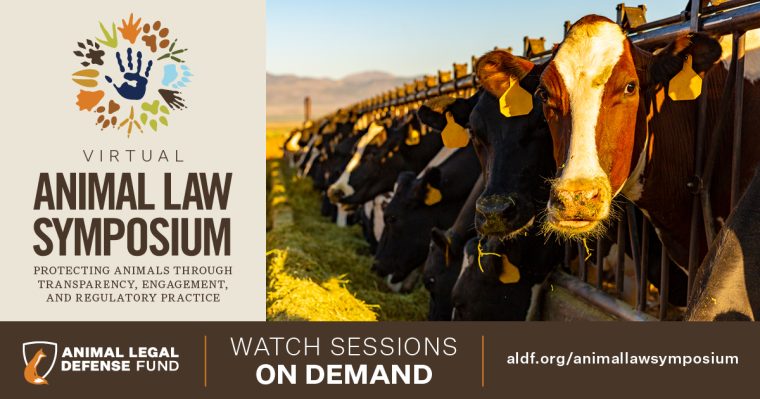
This two-day virtual event brought together leading experts, advocates, and practitioners to examine the evolving legal landscape for animal protection. Expert panels explored how recent federal court and executive branch decisions are reshaping the regulatory landscape; the role of expert witnesses in animal advocacy litigation and enforcement, and how information gathering and storytelling are strengthening advocacy strategies.
The Animal Law Symposium was approved for 5 General Continuing Legal Education (CLE) credits by the Oregon State Bar Association. Most states accept credits from other mandatory CLE states such as Oregon, but please check with your local bar association to confirm.
Questions? Contact events@aldf.org.
Agenda
Thursday, May 7
9:00 a.m. PT / 12:00 p.m. ET – Welcome Remarks
9:00 – 10:15 a.m. PT / 12:00 – 1:15 p.m. ET – Deregulation in Federal Courts
10:15 – 10:30 a.m. PT/1:15 – 1:30 p.m. ET – Break
10:30 – 11:45 a.m. PT / 1:30 – 2:45 p.m. ET - Deregulation in the Executive Branch
Closing remarks
Friday, May 8
9:00 a.m. PT / 12:00 p.m. ET – Welcome Remarks
9:00 – 10:15 a.m. PT / 12:00 – 1:15 p.m. ET – Expert Witnesses in Animal Advocacy
10:15 – 10:30 a.m. PT/1:15 – 1:30 p.m. ET – Break
10:30 – 11:45 a.m. PT / 1:30 – 2:45 p.m. ET – Information Innovation in Animal Advocacy
Closing remarks
Sessions
Deregulation in Federal Courts
This panel explores how recent federal court decisions are reshaping the regulatory landscape and their potential impacts on legal advocacy for animals. Panelists will examine the implications of landmark cases, with particular attention to how growing judicial skepticism of the administrative state affects the future of animal law. The discussion will also consider what these trends mean for advocates seeking to defend and advance regulatory policy.
This presentation took place on May 7, 2026. Watch the full recording.
Speakers:
Nick Fromherz, Independent Consultant & Adjunct Professor, Lewis & Clark Law School
Nick Fromherz is an independent consultant and adjunct professor at Lewis & Clark Law School, where he teaches in the areas of administrative law and comparative environmental law. Based primarily in Bolivia since 2016, Nick previously served as the Latin American program director for the Global Law Alliance for Animals and the Environment at Lewis & Clark from 2020 to 2024. Before that, Nick worked as an attorney for a public-interest law firm focusing on marine wildlife, as a visiting assistant professor at Lewis & Clark, as a commercial litigator in California, and as a law clerk to a pair of federal judges in Detroit and Chicago, respectively. Nick’s scholarship has appeared in the Stanford Environmental Law Journal, the Washington University Global Studies Law Review, the Ecology Law Quarterly, the West Virginia Law Review, Administrative Law Review, Foreign Affairs, and Animal Law Review. When not teaching and writing, Nick consults for NGOs on environmental and wildlife issues in the Latin American region.
Kristen Monsell, Ocean Programs Litigation Director, Center for Biological Diversity
Kristen works with the Center’s Oceans program to protect marine species and their habitat. Before joining the Center, Kristen worked as an assistant attorney general in the Natural Resources Section of the Oregon Department of Justice and as a staff attorney at The Humane Society of the United States in Washington, D.C. She earned her law degree from Lewis & Clark Law School and her bachelor’s degree from Saint Lawrence University.
Delcianna Winders, Director of the Animal Law and Policy Institute and Associate Professor of Law, Vermont Law and Graduate School
Delcianna Winders is an associate professor of law and the director of the Animal Law and Policy Institute at the Vermont Law and Graduate School. Professor Winders previously taught at Lewis & Clark Law School, where she directed the world’s first law school clinic dedicated to farmed animal advocacy. She served as Vice President and Deputy General Counsel at the PETA Foundation, was the first Academic Fellow of the Harvard Animal Law & Policy Program and was a visiting scholar at the Elisabeth Haub School of Law at Pace University. Her primary interests are animal law and administrative law. She has also taught animal law at Tulane University School of Law and Loyola University New Orleans College of Law. Her work has appeared in the Denver Law Review, Florida State Law Review, Ohio State Law Journal, NYU Law Review, and the Animal Law Review. Winders has also published extensively in the popular press, including The Hill, National Geographic, Newsweek, New York Daily News, Salon, U.S.A. Today, and numerous other outlets. Winders received her BA in Legal Studies with highest honors from the the University of California at Santa Cruz and her JD from the NYU School of Law. Following law school, Winders clerked for the Hon. Martha Craig Daughtrey on the United States Court of Appeals for the Sixth Circuit and practiced animal law in a variety of settings.
Moderator: Brittany Peet, Transparency and Regularly Affairs Program Director, Animal Legal Defense Fund
Brittany Peet is the director of the Transparency and Regularly Affairs Program at the Animal Legal Defense Fund. Before joining ALDF, Brittany led the PETA Foundation’s Captive Animal Law Enforcement Division, where she led a multidisciplinary team advocating on behalf of the wild and exotic animals exploited in roadside zoos, traveling shows, and the pet trade. Brittany’s expertise has been featured in major media outlets, and she appeared in the Emmy-nominated documentary series Tiger King and Chimp Crazy, where she discussed the legal and ethical issues surrounding the private ownership of exotic animals.
Resources:
Deregulation in the Executive Branch
Focusing on the executive branch, this panel analyzes how deregulation efforts play out through agency rulemaking, enforcement priorities, and policy rollbacks. Speakers will address key areas including the Endangered Species Act, industrial animal agriculture, and potential changes for animals in laboratories. The panel will highlight both the impacts of deregulation for animals, and the strategies advocates are using to respond.
This presentation took place on May 7, 2026. Watch the full recording.
Speakers:
Tala DiBenedetto, Staff Attorney, Carnivore Conservation Program, Center for Biological Diversity
Tala DiBenedetto (she/her) is a staff attorney with the Center for Biological Diversity’s Carnivore Conservation program, where she has worked to protect imperiled and iconic carnivores like jaguars, coastal martens, and mountain lions from the border wall and other destructive projects, government-sponsored killing, and other threats. Prior to joining the Center, she served as litigation counsel at the PETA Foundation, where she worked on Endangered Species Act cases against roadside zoos. Tala received her J.D. and an advanced certificate in environmental law from the Elisabeth Haub School of Law at Pace University.
Amanda Hitt, Director of Strategic Initiatives, Animal Law and Policy Institute, Vermont Law and Graduate Schoo
Amanda Hitt is the Director of Strategic Initiatives at the Animal Law and Policy Institute (ALPI), where she advances the Institute’s farmed animal advocacy work through the development and execution of high-impact legal, policy, and research initiatives. In this role, she builds coalitions with key stakeholders, serves as a thought leader in the field, creates innovative legal and policy resources, and oversees student research projects.
A champion and visionary for protecting and empowering food system whistleblowers for over a decade, Hitt has represented USDA food safety inspectors working in high-speed slaughterhouses, contract poultry farmers facing exploitative contracts and retaliation, and animal researchers exposing taxpayer-funded waste and cruelty. In addition to litigating cases, she worked to elevate clients’ stories and translate their disclosures into meaningful food system and legal reforms through strategic policy campaigns. Her clients spanned diverse economic sectors and backgrounds, from factory workers to CEOs, reinforcing her belief that durable change requires bringing together voices that are too often kept apart.
Alka Chandna, Vice President of Laboratory Oversight and Special Cases, PETA
Alka Chandna is the Vice President of Laboratory Oversight & Special Cases at PETA. Since joining PETA’s staff in 2003, Alka has liaised with PETA’s research, legal, and investigations teams to cultivate expertise on the use of animals in experimentation. She has submitted dozens of complaints, spotlighting violations of U.S. federal animal welfare laws, guidelines, and policies. In 2010, after she wrote PETA’s complaint against a North Carolina–based contract animal-testing facility, the laboratory surrendered nearly 250 dogs and cats and shut its doors. More recently, she worked on PETA’s successful campaign to end a series of maternal-deprivation experiments on monkeys at the U.S. National Institutes of Health. She has published original research in peer-reviewed journals on policies addressing oversight of animal experimentation and has presented some of this work at scientific conferences. Before coming to PETA, Alka served as a tenured professor of mathematics at Memorial University of Newfoundland.
Moderator: Alyssa Crowell, Senior Staff Attorney, Animal Legal Defense Fund
As a senior staff attorney, Alyssa works in the Transparency and Regulatory Affairs Program (TRAP) and the Animal Law Education & Scholarship Program (ALESP). In TRAP she works on behalf of animals in laboratories, puppy mills, the entertainment industry, and factory farms through data gathering and analysis, strategic litigation support, and regulatory advocacy.
Alyssa has a Bachelor of Arts in Law & Social Thought and Political Science from the University of Toledo and a law degree from Lewis & Clark Law School. While at Lewis & Clark Law School she was a part of her Student Animal Legal Defense Fund Chapter, a member of the Animal Law Review, and participated in the International Environmental Law Project Clinic, which focuses on international wildlife issues. Alyssa also teaches Wildlife Law at Cleveland State University College of Law.
Resources:
- Deregulation: Too Big for One Branch, But Maybe Not for Two
- FDA Announces Plan to Phase Out Animal Testing Requirement for Monoclonal Antibodies and Other Drugs
- Federal Register: Rescinding the Definition of “Harm” Under the Endangered Species Act
- USDA Takes Action To Lower Food Costs on Consumers and Strengthen the Supply Chain through Proposed Changes to Line Speed Rules
- Hitt Presentation Slides
- DiBenedetto Presentation Slides
- Chandna Presentation Slides
Expert Witnesses in Animal Advocacy
This panel explores the critical role expert witnesses play in animal advocacy litigation and enforcement actions. Panelists will share perspectives from criminal prosecutions, wildlife and endangered species cases, and challenges involving animal agriculture. The discussion will cover how experts are selected, prepared, and challenged, as well as best practices for effectively using expert testimony to advance animal protection goals.
This presentation took place on May 8, 2026. Watch the full recording.
Speakers:
Chris Carraway, Staff Attorney, Animal Activist Legal Defense Project, Denver University School of Law
Before joining the Animal Activist Legal Defense Project as a staff attorney, Chris Carraway was a lead attorney for the Colorado State Public Defender. There, Chris handled everything from low-level misdemeanors to first-degree murder; participated in over sixty jury trials; and litigated cases in the Colorado Court of Appeals and Colorado Supreme Court.
Chris graduated from Georgetown University Law Center, where he was president of the student chapters for the National Lawyers Guild and Student Animal Legal Defense Fund. Before that, Chris began his involvement in animal rights activism in his hometown of Raleigh, North Carolina – doing outreach, defendant and prisoner support, and organizing local campaigns against the selling of foie gras and fur. Witnessing the criminalization of animal rights activism in the 00’s compelled him to go to law school. Chris brings his experience as a defense attorney and his passion for animal rights to the Animal Activist Defense Project.
Marcos Hasbun, Partner, Zuckerman Spaeder LLP
Based in Tampa, Florida, Marcos Hasbun is a partner at Zuckerman Spaeder LLP, where he has practiced for more than twenty-five years. He has worked on numerous cases to establish and protect the rights of animals, including both endangered and non-endangered species. In one case, People for the Ethical Treatment of Animals v. Dade City’s Wild Things, Mr. Hasbun, working with lawyers from PETA, successfully obtained the transfer of more than twenty tigers to a reputable sanctuary, a permanent injunction against the defendant roadside zoo, the dismissal of the zoo’s counterclaims with prejudice, and an award of reasonable attorney’s fees and expenses after a two-day evidentiary hearing establishing the zoo’s egregious discovery violations, which a Florida U.S. District Court described as “brazen” and “confounding.” In another case, People for the Ethical Treatment of Animals v. Tri-State Zoological Park of Western Maryland et al., Mr. Hasbun, again working with lawyers from PETA, prevailed in a six-day bench trial, where a Maryland U.S. District Court found that the defendant roadside zoo violated the Endangered Species Act in their treatment of lions, tigers and lemurs. The Fourth Circuit Court of Appeals upheld that ruling, which had forced the zoo to transfer a surviving lion and two tigers to a reputable sanctuary and permanently barred the zoo from possessing any other animals protected under the Endangered Species Act. Some seventy remaining non-endangered animals, including bears, tortoises and a squirrel monkey, at the same roadside zoo were later transferred to reputable sanctuaries after resolution of a subsequent suit against the zoo.
Will Lowrey, Founder and Legal Counsel, Animal Partisan
Will Lowrey is the founder and legal counsel for Animal Partisan, a legal advocacy organization focused on challenging unlawful conduct in animal agriculture and research. Prior to his current role, Will served as legal counsel for Animal Outlook, a national nonprofit farmed animal protection organization, where he divided his time between civil litigation and undercover investigations. Will has substantial experience using private complaint mechanisms to enforce criminal animal protection laws, has used public records law to expose animal cruelty, and has engaged in numerous lawsuits against the government and industrial agriculture, including cases involving administrative challenges, false advertising, public nuisance, and constitutional issues. Prior to joining Animal Outlook, Will clerked in the Superior Court of New Jersey and interned with the Virginia Attorney General’s Animal Law Unit and the Animal Legal Defense Fund. Will taught the first animal law course at the University of St. Thomas School of Law and spends considerable time mentoring law students interested in the field. Before law school, Will worked a lengthy corporate career and in his free time, helped run several non-profits focused on a variety of animal issues.
Moderator: Caitlin Hawks, Chief Programs Officer, Animal Legal Defense Fund
Caitlin Hawks is the chief programs officer at the Animal Legal Defense Fund. Prior to joining the Animal Legal Defense Fund, she founded and oversaw the litigation division at the PETA Foundation. She has handled matters arising under the Endangered Species Act, consumer protection statutes, the First Amendment, public nuisance law, the Freedom of Information Act and state public records statutes, and the Administrative Procedure Act, and likewise advised on criminal animal cruelty issues and proposed legislation.
Before transitioning to animal law on a full-time basis, Caitlin practiced complex commercial and intellectual property litigation at Milbank LLP in Los Angeles and Savitt Bruce & Willey LLP in Seattle and handled a variety of animal law and prisoners’ rights matters on a pro bono basis. She received her law degree from the UCLA School of Law in 2008.
Resources:
- The Veterinarian as Expert Witness In Animal Cruelty Cases, Lockwood
- Using expert knowledge to support Endangered Species Act decision‐making for data‐deficient species
- Veterinary Expert: Legal Nature and Responsibility
- Lowrey Presentation Slides
- Hasbun Presentation Slides
- Carraway Presentation Slides
Information Innovation in Animal Advocacy
This panel highlights innovative approaches to gathering, analyzing, and communicating information to drive change for animals. Speakers will discuss research, data transparency, investigative storytelling, and tools for influencing public opinion and policy. The conversation will focus on how credible, accessible information can strengthen advocacy strategies and accelerate impact across the movement.
This presentation took place on May 8, 2026. Watch the full recording.
Speakers:
Sam Tucker-Davis, Founder, Open Paws
Sam is the founder of Open Paws, a nonprofit organization dedicated to training and deploying animal-aligned AI systems. Open Paws empowers animal-friendly organizations to integrate AI into their operations and advocate for the widespread adoption of animal-alignment in all AI systems. Open Paws’ goal is to create a future where AI respects all sentient life, ensuring animal welfare while also mitigating existential risks to humanity.
With over 15 years of experience in animal advocacy, including five years as the Australia & New Zealand Outreach Manager for Vegan Outreach, Sam is working at the intersection of AI safety and animal advocacy.
karol orzechowski, Resource Director, Faunalytics
karol orzechowski is the Resource Director at Faunalytics. karol is a longtime animal advocate with a passion for advocacy, art, statistics, and tech. In addition to years of investigative work on factory farms, karol is the director of Maximum Tolerated Dose, a feature-length documentary about the psychological toll of vivisection on both animals and humans. He completed a Bachelor of Environmental Studies and an MA in Communications and Culture at York University, writing theses on nationalism and the Atlantic seal hunt, and Canadian rodeo culture, respectively.
Ana Bradley, Executive Director, Sentient Media
Ana Bradley is the executive director of Sentient Media, the only non-profit, nonpartisan newsroom solely focused on reporting on the effects of industrial animal agriculture on the environment, public health, animals, rural communities and climate change. She has led Sentient Media since January 2020.
Prior to Sentient, Ana led an agency in London where she worked with global clients and corporations for over a decade to help build dedicated digital communities. She championed women in tech and community building in creative industries. Ana is an experienced leader, digital content strategist and producer with over ten years of experience designing, producing, and distributing large-scale digital media campaigns.
Moderator: Chris Green, Executive Director, Animal Legal Defense Fund
Chris Green is the executive director of the Animal Legal Defense Fund, where he earlier established the organization’s Legislative Affairs Program and was its director from 2013–2015. Chris spent the past 8 years serving as the inaugural executive director of the Brooks McCormick Jr. Animal Law & Policy Program at Harvard Law School, and he currently is a fellow with the Oxford Centre for Animal Ethics. Green also is the former chair of the American Bar Association’s TIPS Animal Law Committee. In those capacities, Chris persuaded the top three US airlines to stop transporting endangered animal hunting trophies, helped defeat ag-gag legislation in several states, and successfully passed ABA-wide resolutions recommending that all US legislative bodies outlaw the possession of dangerous wild animals and provide police officers with non-lethal animal encounter training. Chris also served on a National Academies of Sciences committee assessing the Dept. of Veterans Affairs’ use of dogs in biomedical research. Chris regularly testifies at legislative hearings on animal protection matters, and he has been quoted on animal legal issues in dozens of major media outlets. Green is a graduate of Harvard Law School and the University of Illinois, where he created the college’s first environmental science degree. Chris also spent several decades working in the fine arts, film, and music industries, and currently manages an Illinois farm that has remained in his family for 186 years. In 2022, Chris received the American Bar Association’s Award for Excellence in the Advancement of Animal Law.
Resources:
- Building Predictive Models for Effective Animal Advocacy
- California’s Avian Flu Safety Rules Are Strong — Their Enforcement Isn’t
- How Many Animals Are Used In Research? A Deep Look At The United States & Canada
- Marine Biologists Are Using AI to Decode Whale Speech. NYU Law Scholars Are Exploring What That Means for Animals’ Legal Rights
- Navigating the Power of Artificial Intelligence in the Legal Field
Related
-
Groups File Opening Briefs in LCFS Biogas Lawsuit
ALDF, as part of a coalition, filed an opening brief in a case to force California’s Air Resources Board to reform its Low Carbon Fuel Standard.September 29, 2026 Press Release -
Cascade County, Montana, Selected for Animal Cruelty Response and Prevention Program
The launch of the program includes a community survey to help the program address animal cruelty and support abuse prevention in Cascade CountySeptember 15, 2026 Press Release -
Clean Water Advocates File Lawsuit Over Oregon Factory Farm General Permit
A coalition of public interest organizations filed a lawsuit challenging the Oregon Departments of Agriculture and Environmental Quality’s new factory farm general permit.July 14, 2026 Press Release