Where Are They Now? Elizabeth Baker
 “Be willing to put yourself in uncomfortable situations,” says Elizabeth Baker, when asked what advice she has for those considering a career in animal law. That wisdom has served Elizabeth well, as it was a sense of discomfort that propelled her to law school after years working in the business field. She realized she needed to pursue a career that would have a positive impact on the world, so she decided to attend California Western School of Law.
She chose a health law and policy concentration and took advantage of every opportunity to learn about the problems with relying on animals in human drug development, the state of science and technology, and current law and policy, and then began working to address these issues. Fortunately, this experience formed the basis for a career that has real impact for humans and animals.
As president of her school’s chapter of the Student Animal Legal Defense Fund (SALDF), Elizabeth had a full plate: co-planning the 2013 California Animal Law Symposium; hosting dinner-and-a-movie nights, including a Blackfish screening and Q&A with the producer; hosting lunch-n-learns with local and national speakers on animal law; and grant-writing for local animal-focused nonprofits. Elizabeth learned to balance the demands of law school, SALDF, and working. Knowing how to manage a very busy life helps Elizabeth now in her current position as senior science policy specialist with the Physicians Committee for Responsible Medicine.
Elizabeth’s role focuses on modernizing the laws, regulations and policies that govern pharmaceutical testing to ensure the testing that occurs before a treatment is tested in humans is more efficient, predictive and relevant to human biology. Elizabeth believes law and policy should create a path for scientific innovation and at the very least must keep pace with science. She collaborates with congressional staff, federal agencies, research organizations, patient advocacy organizations, industry, technology developers, and other stakeholders in the field. All of the public speaking experience she got through SALDF helps her effectively educate stakeholders about the problems that arise from laws and policies that stifle innovation and scientific advances by requiring scientists to use animals in human drug testing, and push for law and policy changes that drive innovation and use of, predictive, human-focused tests.
There’s no doubt that Elizabeth has reached her goal of obtaining a career that has a positive impact on the world. Her profession is unique, because her focus is on improving human health through better science, with the added bonus of saving millions of animals from laboratory testing. “I want to ensure that the people and organizations developing and who want to use modern human-focused technologies have the same support that those currently using the traditional animal methods have,” she says.
Elizabeth also makes the world a better place through her work with a nonprofit dog rescue, where she specializes in fostering pit bulls in need. Life has stayed busy since her days with SALDF, but now she’s enjoying the fruits of her law school labors. Elizabeth advises current law students, “if you work hard, follow through on commitments, are creative and reasonable, you will succeed in establishing a career you love.”
How We Work
Recent News
-
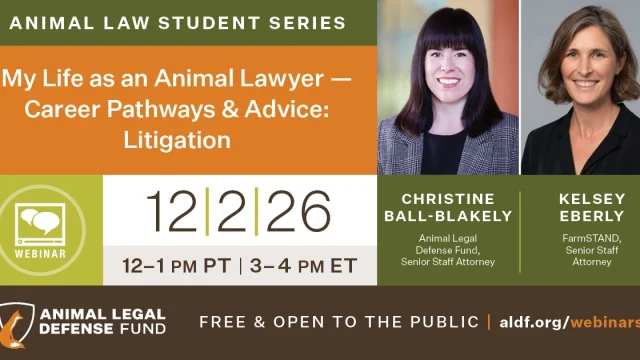
My Life as an Animal Lawyer — Career Pathways & Advice: Litigation
Join us for an upcoming webinar, My Life as an Animal Lawyer: Career Pathways & Advice — Litigation, on Wednesday, December 2, 2026, from 12:00–1:00 p.m. PT / 3:00–4:00 p.m. ET. -
Farm Bill FAQ: What It Means for Animals (2026)
Is the Farm Bill overturning Proposition 12? Does it affect mink farming? Get straight answers on what the 2026 Farm Bill means for farm animals.October 27, 2026 Legal Resource -
Meat in My Cereal?! Hidden Animal-Derived Ingredients in Food
Animal-derived ingredients are hiding in food that many people would never expect. That can be extremely consequential for many consumers for many reasons, including allergies and alpha-gal syndrome. The FDA must require clear product labeling that removes any doubt about what you decide to eat.October 26, 2026 Commentary