Farm Bill FAQ: What It Means for Animals (2026)
What is the Farm Bill?
The Farm Bill is sweeping legislation, renewed roughly every five years, that sets U.S. policy on agriculture, food, and nutrition. It directs billions of dollars toward food and nutrition programs and policies. Because it’s a reauthorization bill, it must be passed on a regular basis or key programs will expire.
The Farm Bill is one of the few major federal legislative vehicles in which animal welfare policy is addressed on a regular basis. This includes funding for animal welfare enforcement, treatment of animals raised for food, and animal welfare standards tied to specific commodity programs, among many other issues.
Why does the Farm Bill matter for animals?
The Farm Bill is critical for animals because it shapes federal policies and funding that directly affect how animals are raised, transported, treated, and regulated. It can establish or change programs governing the treatment of farmed animals, puppy mills, horses, wild animals, conservation, as well as dictate enforcement of federal animal protection laws.
Since the Farm Bill is renewed periodically and involves hundreds of billions of dollars in federal policy and spending, it provides an important opportunity to advance meaningful protections for animals while preventing provisions that could weaken existing safeguards.
What about the “Save Our Bacon Act” / EATS Act provision?
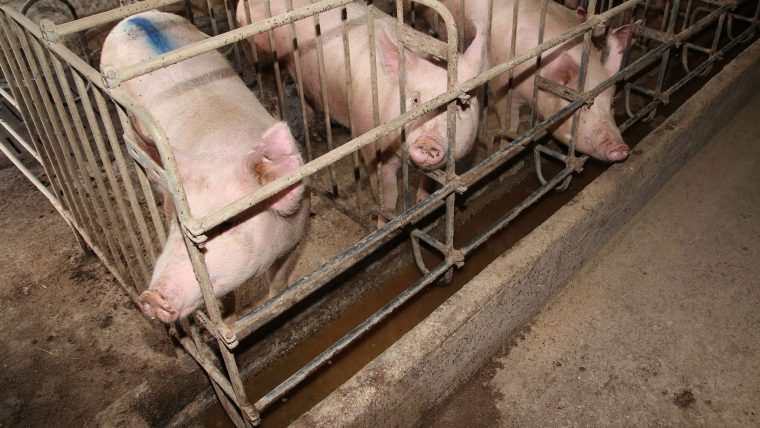
The Save Our Bacon Act (SOBA) (H.R. 4673) is a slightly narrowed reintroduction of the more commonly known Ending Agricultural Trade Suppression (EATS) Act, which is designed to undermine state animal protection laws like California’s Proposition 12. It would limit states’ ability to pass laws to regulate their own agricultural industries and would nullify state laws intended to protect farmed animals from extreme confinement – as well as hundreds of other state laws intended to protect animals, consumers, farmworkers, the environment, and public health.
SOBA is a standalone bill, but the language from it has also been included in the House-passed 2026 version of the Farm Bill. It has not been included in the Senate version thus far, but it is still a significant risk as the chambers continue to negotiate a final bill.
Does the Farm Bill affect animal-welfare laws?
The Farm Bill impacts federal animal protection laws in addition to potentially impacting state-level laws. It shapes federal agriculture policy, funding, and programs that affect billions of farmed animals and has the potential to either further animal welfare or undermine it. For instance, it can include funding for greater enforcement, mandates for increased inspection, or reporting requirements for the Humane Methods of Slaughter Act, a federal law designed to protect farmed animals from extreme suffering at slaughter.
It can also dictate protections for farmed animals during natural disasters, restrictions on antibiotics and use of harmful animal drugs, funding for farmed animal disease surveillance and prevention, and the National Organic Program, which creates standards for how organically-raised animals must be housed and treated.
Because the Animal Welfare Act (AWA) – the federal law that governs the treatment of commercially bred, raised, and exhibited animals – also falls under the jurisdiction of the United States Department of Agriculture, provisions mandating AWA funding and enforcement are frequently included in the Farm Bill.
What is California’s Proposition 12? Does the Farm Bill override Proposition 12 even though the Supreme Court already upheld it?
In 2018, California voters passed Proposition 12 to treat farmed animals more humanely. It sets minimum space requirements for farmed animals and prohibits the sale of animal products from farmed animals raised in extreme confinement, including animals raised in other states. In May 2023, the Supreme Court upheld Proposition 12, rejecting a pork industry challenge and ruling that the law does not violate the U.S. Constitution. The Ending Agricultural Trade Suppression (EATS) Act was introduced in Congress shortly after as a response to this ruling, followed by the Save Our Bacon Act and inclusion of this language in the House-passed Farm Bill.

What does the Farm Bill have to do with mink farming?
For more than three decades, federal law has prohibited federal funds from being used to promote mink exports, yet both the 2026 House and Senate Farm Bills include provisions to reverse this longstanding ban.
Since the original decision to ban taxpayer support, zoonotic disease risk has grown considerably. Mink have been identified as viral “mixing vessels,” capable of contracting and mutating diseases like COVID-19 and avian flu and transmitting them back to humans — a risk exacerbated by the stressful and unsanitary conditions on fur farms.
This growing risk comes as the mink fur industry has shrunk considerably over the past 30 years and often operates at a loss, which is related to broader shifts in consumer attitudes as fashion brands, retailers, and shoppers increasingly turn away from fur products on ethical and environmental grounds. It also mirrors a broader global trend: more than 20 countries, including the UK, France, and the Netherlands, have moved to ban or phase out fur farming entirely, often citing the same animal welfare and public health concerns now being raised in the U.S. Restoring taxpayer support would mean propping up a dying, increasingly risky, and inhumane industry that poses serious public health threats, rather than serving any broad economic need.
Has the Farm Bill helped animals before? Can it in the future?
The Farm Bill has been used as a vehicle to help animals often in the past and continues to be one of our most feasible options for passing federal animal protection provisions in the future. Some examples include:
- The 2014 Farm Bill made it a federal crime to knowingly attend an animal fighting exhibition.
- The 2018 Farm Bill expanded the federal ban on animal fighting to U.S. territories.
- The 2018 Farm Bill prohibited the slaughter of dogs and cats for human consumption.
- The 2018 Farm Bill included the PAWS Act, which provides federal funding for programs providing temporary shelter for domestic violence survivors and their pets.
These victories illustrate that the Farm Bill is a powerful tool to advance protections for all kinds of animals and we must continue advocate for inclusion of animal welfare provisions in future Farm Bills.
How does the Farm Bill become law?
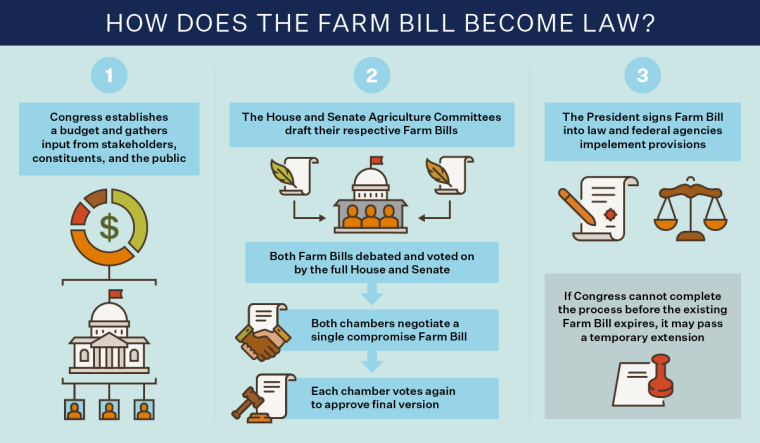
Each Farm Bill follows a multi-step process that begins well before the current Farm Bill expires. First, Congress establishes a budget and gathers input from stakeholders, constituents, and the public through listening sessions, town halls, and other opportunities. This input can help shape what provisions are ultimately included.
Next, the House and Senate Agriculture Committees draft and mark up their respective Farm Bills before sending them to the full House and Senate for debate and votes. Because the two chambers’ bills often contain different provisions, members of both chambers then negotiate a single compromise bill. Each chamber must vote again to approve the final version before it goes to the President for signature.
Once signed into law, federal agencies—particularly USDA—implement the Farm Bill’s provisions. If Congress cannot complete the process before the existing Farm Bill expires, it may pass a temporary extension to keep programs operating while negotiations continue.
What’s the status of the Farm Bill right now [October 2026], and why does the timing matter for animals?
Congress has been trying to pass a new Farm Bill since 2023, but has yet to do so. The House and Senate have been working on their own Farm Bills; the House passed its version in April 2026 and the Senate Agriculture Committee passed its version in September 2026. The Senate Version has not been scheduled for a floor vote.
The extension of the 2018 Farm Bill expired on September 30, 2026, so Congress now must either complete a new Farm Bill or pass an additional extension. With this Congress coming to a close at the end of 2026, they are running out of time to do so – but we anticipate an attempt to get the Farm Bill passed into law after the 2026 midterm elections. Because there is still time for passage this Congress, we must remain vigilant and continue putting pressure on members of Congress not to include harmful provisions, like the Save Our Bacon Act in the final version.
What can I do to influence the Farm Bill?
It is critical that members of Congress hear from their constituents. You can speak up for animals by contacting your U.S. representative and senators and urging them not to include provisions that would undermine states’ ability to set agricultural policies within their own borders. You can also urge Congress to ensure that no federal funding supports the cruel mink-farming industry.
Calling your members of Congress is one of the most direct ways to make your voice heard, but you can also contact them by email or engage with them on social media.

Tell your senators to oppose the Farm Bill!
Different versions of the Farm Bill have now passed the full House of Representatives, and the Senate Agriculture Committee (the Senate bill now heads to the Senate floor). Take action for animals today!

Focus Area
How We Work
Related
-
NYC Council Passes Romanch’s Law in Historic Vote to End Horse-Drawn Carriages by 2028
The bill will responsibly phase out the horse drawn cab industry to make NYC safer for allOctober 22, 2026 Press Release -
ALDF Announces Caitlin Hawks as New Executive Director
The Animal Legal Defense Fund today announced Caitlin Hawks as its new executive director.October 21, 2026 Press Release -
Group Seeks Federal Action to Protect the Last Remaining Solitary Pet Chimpanzee in the U.S.
Bow, an endangered chimpanzee, is being held in solitary confinement in violation of federal lawOctober 20, 2026 Press Release