There are many more Ridglans. Here’s what the government should do to protect every dog at risk of laboratory testing
Stacy Lopresti-Goodman, Ph.D., Director of the Animal Law Education and Scholarship Program
There’s good news for dogs in research. Ridglan Farms, a notorious Wisconsin-based breeding facility that supplies dogs for research, is shutting down. For decades, Ridlgan confined more than 2,000 puppies and dogs at its facility, some of whom were also used in experiments on site. For the animals being released, it means a long-awaited chance to experience life outside a cage and in a loving home. That’s welcome news. But at the same time, there are tens of thousands of other dogs in the same situation. There’s much more we need – and can – do to solve the larger problem, starting with federal reform.
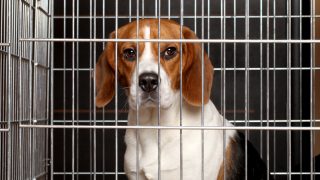
Ridglan has drawn national attention over the past few months following animal activists’ attempts to remove dogs from the property. Images of beagles confined to small, barren cages, deprived of meaningful social interaction and environmental stimulation, have shocked the public. Yet these conditions are not illegal. They meet Animal Welfare Act (AWA) standards, the federal law that governs how animals may be housed and used in research and breeding facilities.
Under the AWA, dogs can be kept in enclosures only six inches longer than their bodies. Having just enough room to spin in circles inside their cage meets the current requirements for “exercise.” This is because federal regulations focus primarily on physical needs, including providing food, water, and shelter, while failing to account for animals’ social and psychological needs and the suffering caused by confinement, isolation, and deprivation.
Before joining the Animal Legal Defense Fund, I was a tenured psychology professor. During that time, I reviewed footage from inside Ridglan to provide expert testimony for a lawsuit. I observed dogs engaging in repetitive pacing, circling, and withdrawn postures. Decades of animal welfare science tell us that these behaviors are not normal. They are indicators of chronic stress and compromised well-being. Yet under current regulatory frameworks, this type of suffering is largely invisible.
The public and law makers’ response to Ridglan reflects something important: people care deeply about dogs. This facilities closure shows that public attention and advocacy can make a difference. But it also underscores the limits of case-by-case solutions. If we cannot ensure meaningful protections for an animal widely regarded as a member of the family, what does that say about the millions of other animals used in research who receive even fewer safeguards?
Earlier this year, the U.S. Department of Agriculture (USDA) sought input from scientists, activists, and the public regarding updating regulations governing dog breeding, housing, and socialization. On behalf of ALDF, I submitted expert comments recommending meaningful reforms. But federal standards should require more than minimal survival; they should reflect animals’ behavioral and psychological needs. We also need laws that mandate the use of alternatives when they exist, ensure that animals are placed for adoption when no longer being used, and that restrict research involving animals. There’s no reason any dog should be subject to laboratory testing, and the USDA has the power to start changing that.
Members of the public can play a role in this process by contacting their members of Congress encouraging them to support policies that strengthen protections for animals in laboratories and breeding facilities.
The transfer of beagles from Ridglan to rescue organizations saved the lives of those 2,000 individuals, who are all deserving of a better life. But without broader legal reform, thousands more will take their place inside laboratories. The solution is not just to move animals through the system; it is to change the system itself.
The Animal Legal Defense Fund works through litigation, legislation, and advocacy to strengthen protections for animals used in research, reduce animal testing, and to promote policies that provide pathways to adoption. There is a better way, and Ridglan reminds us that these steppingstones can and should lead us to larger, systemic change.
Because we all know: Dogs belong in laps, not labs.
-
Stacy Lopresti-Goodman
Director of the Animal Law Education and Scholarship Program



Sign Up!
Join the Animal Legal Defense Fund's email list to stay up to date on lawsuits, legislation, and regulations affecting animals.
Focus Area
Related
-
How to Keep Dogs Safe This Summer
Hot Weather Tips from the Animal Legal Defense FundMay 26, 2026 News -
City of Sturgeon Agrees to Pay $500,000 in Settlement Over Police Shooting of Blind, Deaf Dog
The lawsuit argued the lethal force used violated the 4th amendmentNovember 14, 2025 Press Release -
A Dog Named Smokey Reunites with Guardian After Being Kidnapped
The Animal Legal Defense Fund partnered with spcaLA to take custody of the dog until his guardian could retrieve himOctober 7, 2025 News