
Captive Primate Safety Act (Federal)
(H.R.3199/ S.1594)
The Captive Primate Safety Act prohibits the private possession of nonhuman primates as well as the breeding, sale, or transport of these animals for the “pet” trade.

Status
Nonhuman primates, such as apes and monkeys, are highly intelligent animals with complex psychological and physical needs. Nonhuman primates cannot be kept safely or humanely as “pets” and even the most well-intentioned owner cannot replicate the intricate family structures and social stimulation that species like chimpanzees and orangutans need to flourish. A residential home is not equipped to meet nonhuman primates’ physical needs, which vary greatly depending on species, but generally require large natural landscapes with trees, hillsides, and places to climb and perch.
Despite this, the lack of comprehensive federal regulation and the inconsistent patchwork of state and local laws allow many primates to be kept in private homes throughout the United States. The total number of “pet” primates is unknown, but most estimates suggest there are thousands if not tens of thousands.
Although federal law prohibits the importation of primates for the pet trade into the United States, the patchwork of state and local laws governing private ownership—often varying by species—continues to enable the private primate trade to flourish. A simple Google search can produce hundreds of listings advertising a variety of primate species for sale, while the rise of social media has increased the visibility and accessibility of “pet” primates. Although some animals are sold by breeders – both licensed, and unlicensed – primates are also acquired illegally through the wildlife trade. Though some states have regulated the private possession of nonhuman primates, this patchwork of inconsistent laws makes enforcement challenging and is insufficient to ensure both nonhuman primates’ well-being and human safety. A federal solution is needed.
The Captive Primate Safety Act ( H.R.3199/ S.1594), sponsored by Sen. Richard Blumenthal (D-CT), Rep. Mike Quigley (D-IL-05), Rep. Brian Fitzpatrick (R-PA-01), Rep. Nancy Mace (R-SC-01), and Rep. Julia Brownley (D-CA-26), would make it illegal for private individuals to own any live nonhuman primate—including chimpanzees, gorillas, orangutans, monkeys, lemurs, gibbons, and other primate species—or to breed, buy, sell, transport, or trade them across state or international borders for the pet trade. This bill is narrowly tailored to private possession, and exempts accredited zoos, universities, and sanctuaries. Current primate owners would be grandfathered in but are required to register their animals so that first responders and animal control officers are aware of the presence of wild animals in their communities.
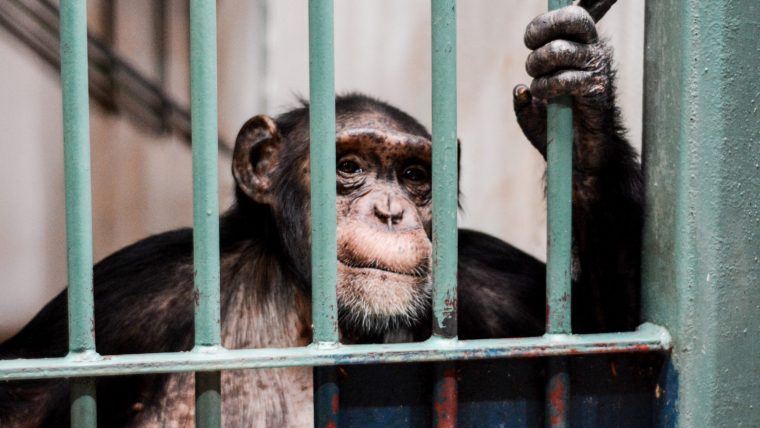
Keeping nonhuman primates as “pets” poses a serious safety risk for both the animals and nearby humans. These wild animals, even smaller species, are unpredictable and can be aggressive, and pose a public health risk to humans, as they can transmit a wide range of zoonotic diseases, such as measles, herpes, and viral hepatitis.
Over the last three decades, at least 300 people have been injured by nonhuman primates held in private homes and facilities. In one high-profile incident, a Connecticut woman named Charla Nash suffered severe facial injuries after she was attacked by a 200-pound chimpanzee, Travis, kept in her friend’s home. Travis was subsequently shot and killed by a police officer responding to the scene, who spoke years later about the toll the incident took on his mental health. Senator Blumenthal was inspired, in part, by Charla’s story to sponsor the Captive Primate Safety Act.
The Animal Legal Defense Fund strongly supports the Captive Primate Safety Act and encourages local and state governments to continue to enact legislation prohibiting the private possession of nonhuman primates.
U.S. Residents: Urge your legislators to support the Captive Primate Safety Act!
Send your federal legislators a letter to urge them to co-sponsor the Captive Primate Safety Act.

Sign Up!
Join the Animal Legal Defense Fund's email list to stay up to date on lawsuits, legislation, and regulations affecting animals.