State Animal Protection Laws Ranked: Oregon is #1, North Dakota #50
20th edition of ALDF state and territory ranking report highlights major advancements & trends in animal protection across the U.S.
Contact: media@aldf.org
WASHINGTON — The Animal Legal Defense Fund (ALDF), the nation’s preeminent legal advocacy organization for animals, has released the 20th annual U.S. Animal Protection Laws Rankings Report (2025), ranking the animal protection laws of all 50 states, and featuring major progress and trends in animal protection across the country, including domestic violence protections, declaw bans, and rescue laws.
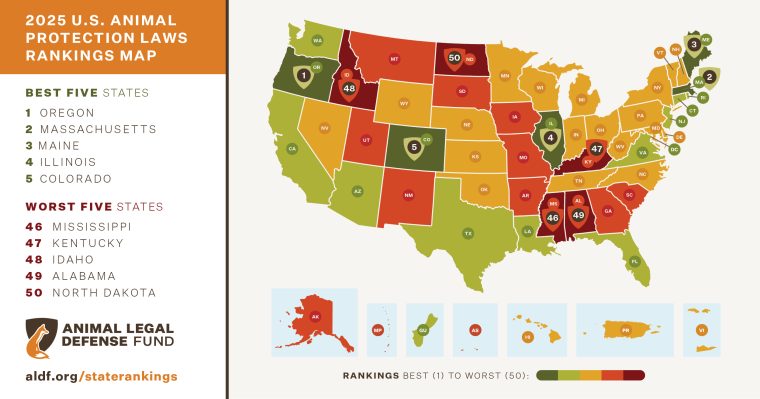
Oregon has claimed the top rank in animal protection laws for the third year in a row — followed by Massachusetts (2), Maine (3), Illinois (4), and Colorado (5). In 2025, North Dakota holds the bottom spot in the rankings at 50th place for the third year in a row, with Alabama (49), Idaho (48), Kentucky (47), and Mississippi (46) rounding out the states with the weakest animal protection laws.
Since tracking began 20 years ago, there have been many advancements in animal protection law. Most notably, when the report was first developed, there weren’t any jurisdictions that explicitly permitted animals to be included in domestic violence protection orders, and now 42 states and two territories do so. In 2005, there were only 21 states and one territory requiring or explicitly permitting veterinarians to report suspected animal cruelty, and now there are 44 states and two territories. Finally, the number of jurisdictions permitting courts to order possession bans, prohibiting convicted offenders from owning or possessing animals, in 2005 was 22 states and one territory and has increased to 42 states and four territories.
“This report represents 20 years of incredible progress in creating and expanding protections for animals of all kinds in states all across this country, as well as in the U.S. territories,” said ALDF Executive Director Chris Green. “These advancements are thanks to the persistent hard work of animal advocacy organizations, lawmakers, and members of the public who have worked together to help create essential protections for the animals we cherish — and who all deserve the right to live free from harm. There’s always more to do to expand, strengthen, and enforce animal protection laws, but this report shows that momentum is on our side, and accelerating.”
The most-improved jurisdictions in 2025 were Nevada and Tennessee, which rose five and four places in rank, respectively. Both states enacted multiple new protective measures for animals in 2025, including strengthening their laws regarding psychological evaluations and treatment for those convicted of animal cruelty offenses. One of the primary goals of sentencing in criminal cases should be to identify and address underlying causes of the offense. Requiring psychological evaluations for animal cruelty offenders can provide vital information, ensuring the person convicted can have access to any necessary rehabilitative resources, which in turn promotes safety in our communities — for both humans and animals alike.
A new trend highlighted in the report is laws prohibiting declawing cats. Cat declawing, or onychectomy, is an invasive surgical procedure that involves amputating the last bone of each of the cat’s toes. When cats undergo declawing procedures, they suffer both physically and psychologically. The first state to ban cat declawing was New York in 2019. In 2025, the number of states banning cat declawing doubled, from three to six, with California, Massachusetts, and Rhode Island all enacting laws that year. Each of these six states, and the District of Columbia, now prohibit the unnecessary declawing of cats, and limit the procedure to cases in which the declawing is necessary for a “therapeutic purpose,” such as to treat a cat’s injury or illness.
Another trend in 2025 was the creation of new laws and the expansion of existing laws to allow law enforcement and civilians to rescue animals in imminent danger, including animals left without food and water as well as animals left in hot cars. Arkansas, Washington, and Nevada passed these types of laws last year. The majority of states, as well as Guam and Washington, D.C., now have laws of this kind.
The rankings are based on a comprehensive review of each jurisdiction’s animal protection laws, including over 3,600 pages of statutes. This is the longest-running and most authoritative report of its kind and tracks which states are taking animal protection seriously.
The full report, including details about each state, is available at aldf.org/rankings.

Sign Up!
Join the Animal Legal Defense Fund's email list to stay up to date on lawsuits, legislation, and regulations affecting animals.
How We Work
Related
-
Court Rules Texas Food Label Censorship Law is Unconstitutional
The law imposed unclear and vague standards on plant-based meat producers that violate the First AmendmentJanuary 29, 2026 Press Release -
Over 30 Organizations Urge USDA to Limit Federal Support for Manure Digesters
Hundreds of millions of dollars intended to cut energy costs have been funneled to costly manure digesters, benefitting the largest factory farmsJanuary 15, 2026 News -
Resolution Opposing Elective Cat Declaw Surgeries Introduced in the U.S. House of Representatives
Declawing is a cruel surgical procedure to remove the last bone in a cat's toesDecember 16, 2025 Press Release